
With emotion, the Greek Minority in Albania honored October 28th, where many Greek soldiers left their bones, which for decades were abandoned in ravines, ravines and canyons and have been collected in recent years.
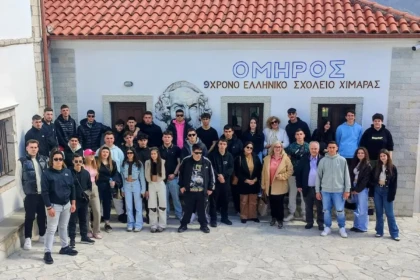
A memorial service was held at the Kleisoura cemetery. In Vouliarates, a student parade took place from the village school to the Military Cemetery. This was followed by a eulogy and a memorial service at the Vouliarates military cemetery, officiated by Metropolitan Nathanael of Gjirokastër, where wreaths were laid.
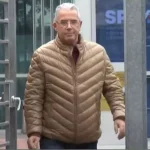
The Greek government was represented by the Secretary General of Hellenes Abroad and Public Diplomacy Maria Bogri-Anni, who spoke about the unparalleled ideal of freedom that the Greeks defended and emphasized the need for unity.

Present were the greek Ambassador to Tirana, Konstantina Kamitsi, the Consul General Of Gjirokastra, Socrates sourvinos, the new Democracy MEP, Fredy beleri, etc., as well as many pilgrims from Greece.
In the greetings, it was emphasized that memory helps to keep the memory of people and historical moments alive. With memory, we honor all those who sacrificed themselves for a supreme ideal: Freedom. Collective memory keeps the links of the chain of the present with the past solid, as it does not allow for the separation or selective description of moments and situations. Their graves are a symbol of heroism and hope. A symbol of inspiration and exemplary leadership.
It should be noted that at the cemetery of Saint Athanasius in Vouliarates, a trisagio was held on October 28, at the grave of Konstantinos Katsifas.
Other events

On October 27, a celebration of the Dervitsani Unified School was organized in Dervitsani to celebrate October 28 with dances and poems. The Greek Ambassador to Tirana, Konstantina Kamitsi, the Consul General of Gjirokaster, Sokratis Sourvinos, and the mayor of Dropoli, Dimitris Tolis, were present.
Also at the Dervitsani Cultural Center, the inauguration of the Municipal Art Gallery - Sculpture Gallery of Dropoli took place, a space dedicated to the Art, Memory and Soul of Dropoli, where works donated by artists are displayed.
The event was attended by Metropolitan Nathanael of Gjirokastra, the Ambassador of Greece in Tirana Konstantina Kamitsi, the Consul General of Greece in Gjirokastra Sokratis Sourvinos, artists, representatives of organizations and a multitude of citizens.
Art — as emphasized at the event — is not a luxury, but a way to keep memory alive, to express what cannot be put into words.
Moreover, on the same day, the Omonia branch of Himara held the established memorial service at the 1940 Fallen Monument (Ermioni Brigou), where wreaths were laid. Among those who laid wreaths was the MEP from Himara, ND Fredy Beleris.

The military cemeteries
It should be noted that the history of military cemeteries in Albania began in 1981.
Enver Hoxha was then asked to collect the bones. Assuming that they would be transferred to Greece, as the dead Italian soldiers had previously been transferred to Italy, he gave permission to search for mass graves. But at that time and for many years afterwards, the issue remained dormant.
The first organized military cemetery was created in Vouliarates, in the area where a field hospital of the Greek army operated in 1940-41 and those who succumbed to their wounds were buried.
The other cemetery in the narrows of Kleisoura was created at the initiative of the Archbishop of Albania Anastasios. Scattered graves of Greek soldiers exist in many parts of Northern Epirus.
From the study of the archives, combined with the cross-checking of information, oral and recorded in the personal diaries of warriors, evidence emerged that during the war, makeshift cemeteries had been created in the areas of Dragoti, Delvino, Vodino, Himara, Erseka, Devol, Vouliarates, Pogradec, Premet, Kleisura, Korca, Bogazi, Rondoni, Morava, Kyparo, Plativouni, Goliko, Trebesina, Punta Norne, Skoutara, etc.
The spears were raised
The spears rose proudly in pyramids on the mountains and in the valleys. It is not easy to describe the macabre mingling of spears with flesh, the horror of the winged holo-grenades, the fire of the hand grenades, which exploded inch by inch at the feet of the brave warriors, the chain hiss of the machine guns, something of the thunderous crackling of the artillery shells, which thus held the “bass” in the entire military concert!…
However, it is easy to describe the strength and ethos of the greek soul, which may be wounded today, but is always courageous.