
On this day, December 17, 1913, The international Committee Of the Great Powers (England, France, Russia, Austria, Germany, Italy) for the demarcation of borders, which had undertaken the settlement of the borders of the newly established albanian state, proceeded to Draft the Florence protocol, which ultimately led to the partition of the unified Continent.
Based on this protocol, the entire Northern Epirus, including its historical regions such as Himara, Delvino, Gjirokastra, Premet, Leskoviki and Korçë, would now fall under the Albanian state.
From that moment on, the continuous struggle of Northern Epirus Hellenism for vindication began to take shape, but it never came.
With this protocol, the cradles of Northern Epirus are deprived once and for all of their Motherland, although struggles and liberations followed, which were constantly canceled by the Great Powers and their interests in the region.
Due to political expediency and the shameful interventions of Italy and Austria-Hungary, Northern Epirus remained in Albania and its inhabitants were either forced to abandon their land en masse, or a few decades later to be confined to arbitrary minority zones, which in the process even changed the acceptance of the people of Northern Epirus among themselves.
Great struggles and many protests followed, culminating in the short-lived Autonomy of Northern Epirus.
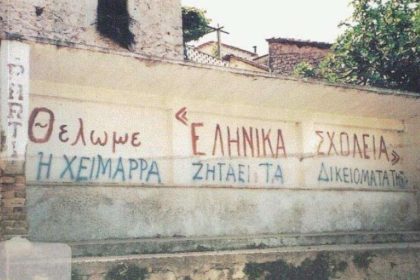
However, after the end of the Northern Epirus Struggle, the process of systematic Albanianization of the Greeks began, which managed to cause damage mainly to populations that during the Ottoman Empire had adopted the Albanian language as their primary language or were bilingual. The same also happened to the Vlach-speaking Greeks.
The above actions culminated during the Hoxha regime, where they brutally wounded the conscience of the people.
The following is an excerpt from the Florence Protocol, December 17, 1913:
«Περιγραφή: Η οροθετική γραμμή αναχωρεί εκ του σημείου (επί του Αυστριακού Χάρτου υψόμετρον 1738 Β.Α της Μάνδρας Νικολιτσάς), ένθα η μεσημβρινή μεθόριος του Καζά Κορυτσάς ενούται με την οφρύν του Γράμμου μέχρι Μαύρης Πέτρας. Κατόπιν διέρχεται δια των υψομέτρων 2.538 και 2.019 και φθάνει εις Γόλο. Εκείθεν αφού ακολουθήσει την διανομήν των υδάτων μέχρι του υψομέτρου 1.740, διέρχεται μεταξύ των χωρίων Ραδάτα και Κουρσάκα, διευθύνεται εις λόφον τον ευρισκόμενον ΒΑ του Κούκεσι, όθεν καταβαίνει όπως φθάσει εις Σαρανταπόρον. Ακολουθεί την κοίτην του ποταμού τούτου μέχρι της εκβολής του εις τον Αώον, όθεν φθάνει εις την κορυφήν του όρους Τούμπα, διερχομένη μεταξύ των χωρίων Δεπαλίτσα και Μεσσαρία και δια των υψομέτρων 1956 και 2.000.
From the top of mount Toumba, the line heads east at an altitude of 1621, passing north of Drymades.
Κατόπιν ακολουθεί την διανομήν των υδάτων μέχρι του υψώματος του ευρισκομένου ΒΑ του χωρίου Επισκοπή. Εκείθεν διευθύνεται προς ανατολάς, ακολουθούσα την οφρύν μεταξύ Ραδάτης όπερ μένει εις την Αλβανίαν και Γεδοχάρ, όπερ μένει εις την Ελλάδα, καταβαίνει εις την Κοιλάδα του Δρίνου και, διαπερώσα του ποταμού, αναβαίνει επί του λόφου Κακαβιά, χωρίου, όπερ μένει εις την Αλβανίαν. Ακολουθεί αύθις την διανομήν των υδάτων, αφίνουσα την Βάλτιστα (σημ. Χαραυγή) και Καστάνιανην εις την Ελλάδα, την δε Κοσσοβίτσαν εις την Αλβανίαν και φθάνει εις Μουργκάναν, υψόμετρου 2.124. Εκείθεν φθάνει εις το όρος Στουγάρα και δια Βερτόη και του υψομέτρου 750 αφήνουσα την Γιανναρήν και Βέρβαν εις την Αλβανίαν, διέρχεται δια την υψομέτρων 1014, 675, 839 μ. διευθύνεται ΒΔ, αφήνουσα δε την Κονίσπολην εις την Αλβανίαν, ακολουθεί την οφρύν των λόφων Στύλου και Όρμπα, πριν ή δε φθάσει εις το υψόμετρον 254 μ. στρέφεται νοτίως και φθάνει εις τον όρμον της Πτελέας (Φτελιάς)».