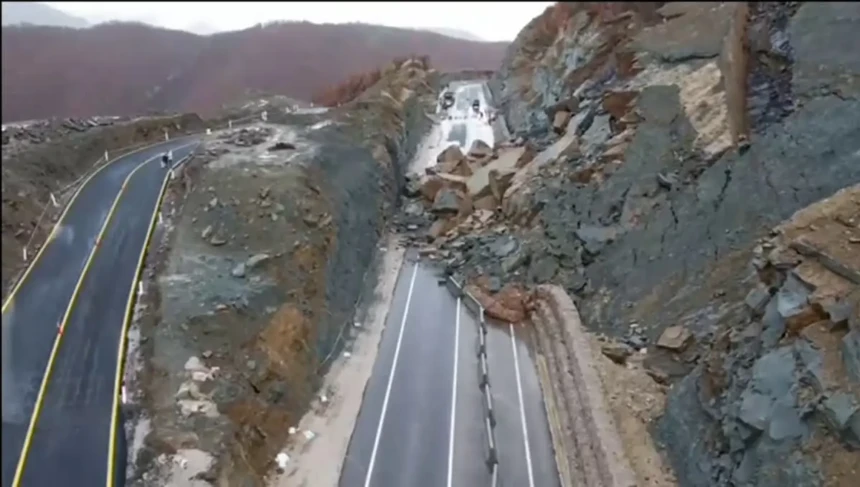
Albania's central road axis, Qukës-Qafë Plloçë, a project that for years has been presented as one of the most costly and much-discussed interventions in Albanian road construction, collapsed with the first serious rainfall of the autumn, causing a new wave of reactions about the quality and safety of the project.
The images from the scene are revealing: the cliff has given way, huge rocks have fallen onto the road, the parapets have buckled and parts of the road show damage as if they had suffered a strong impact. The landslide occurred in an area where the mountain had been cut to a great depth, without the necessary reinforcement of the slopes, exposing the road to immediate danger.

The collapse of the materials completely blocked traffic, forcing the maintenance company to reopen a makeshift side road to continue the crossing, albeit with difficulty. This is one of the most serious failures to have occurred on this route, which just a few months ago was presented as a “ready-to-use project”.
Despite the clear failure in the durability of the construction, the Albanian Road Construction Fund (ARRSH) was quick to attribute the event exclusively to "heavy rainfall", ignoring any possibility of construction negligence or poor design on a road that passes through particularly demanding mountainous terrain and that has cost outrageous amounts by the country's standards.
The fact, however, raises reasonable questions: how is it possible that an investment of hundreds of millions of euros can succumb so easily to natural phenomena? Why does a road that has been absorbing public funds for decades present such a picture after a common autumn storm? The new failure comes in addition to a long series of criticisms of cost overruns, constant delays and ambiguity regarding the quality of the work.
The Qukës-Qafë Plloçë axis is located in central Albania and is a key link between Librazdë and Pogradec, acting as an important gateway to the eastern side of the country. Despite its strategic importance, sixteen years after the start of the project it remains a symbol of a problematic model of public works: high costs, controversial technical solutions and a result that does not meet either the investment or the needs of drivers.
Crews are still working to remove the debris, while authorities are considering new measures to restore traffic. However, the recent collapse is reigniting debate about how Albanian institutions manage large projects and whether there is effective control over the quality and transparency of public investments.