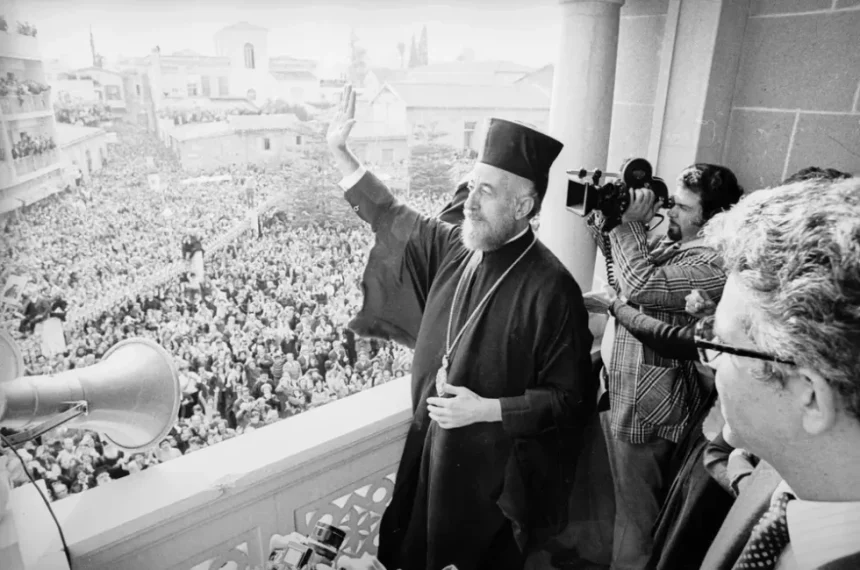
The case of Archbishop Makarios III is that of a hierarch and politician with an extremely turbulent life. A life full of contradictions, immature and stagnant revolutionary and political actions, with a common component being his fiery temperament.
A temperament identical to that of Eleftherios Venizelos, against whom assassination attempts had been made at the initiative of pro-royalists - for the most part - from 1904 (a year before the Cretan revolution of Therisos) until 1933. A temperament that caused a storm in the souls of Greeks and, mainly, of the Greeks of Cyprus, in the case of Archbishop Makarios.
And this storm translated into blind hatred on the one hand and worship on the other. In a division of the world on the island ("Blessed" VS "Griviki") in the... models (negative, undoubtedly) of the National Division in Greece.
A division that, in the Greek case, stirred up – even half a century after Venizelos' death (1936) – "Philippine" attacks against him and libels from journalists, while in the Greek Cypriot case it had divided the Cypriots into friends of Makarios (who apotheosized him as the "greatest post-war Greek") and his enemies (who called him a "traitor").
The positive characteristics shared by both men include their militancy (they were born warriors – in addition to being good diplomats – and drew courage for new struggles from their defeats) and their democracy, which led them to ideological outbursts against fascism and Nazism (Hitlerism) and in favor of the idea of the freedom of peoples.
The consequence of this stance was the murderous attacks by royalists against Venizelos and by "Grivik" far-rightists against Makarios during the Greek dictatorship (1967-'74), culminating in the coup of 1974 (there had already been dozens of attempts against the Archbishop since '56 and onwards (the first at the initiative of the British colonialists, who sent him to prison for 13 months in the Seychelles, during the stormy national liberation struggle of EOKA in Cyprus in 1955-1959).
The 1974 coup against Makarios, it should Be noted, was planned and executed By the Ioannides junta and resulted in his ouster and replacement in the presidency Of cyprus By the friend of the "invisible dictator" Samson [July 15, 1974 – July 24, 1974], a fact that gave the Turks reason for their invasion of Cyprus [Attila 1&2]).
It was a disastrous coup that was not prevented, despite the foresight of the Cypriot government – from late 1973, when the crisis in Athens-Nicosia relations was at its peak – to draw up an operational plan to counter the coup, under the name ASPIS 3.
Despite the Archbishop's foresight to equip the forces that had been organized for the resistance with 1000 automatic weapons from Czechoslovakia, which were secured by a special mission by the director of the Central Intelligence Agency and his associate Georgios Tombazos. Weapons that were delivered to the presidential guard on July 9, six days before the coup of July 15...
A foresight that was probably stretched to its limits, burdened by makarios' Anxieties for his personal survival, although the incessant attempts against him never frightened him. they only embittered Him as much as the existence of his internal enemies, the denial of his personal expectations, and the betrayals of his friends and allies.
His abandonment by the Arabs, above all, even though he defended them strongly against Israel in '67, in the 7-day war. But they reciprocated this with a show of ingratitude, given that Gaddafi literally played a trick on him...
His abandonment by the "Non-Aligned", who were Makarios' "trump card", although some of them - as it turned out before the Turkish invasion - supplied Attila with oil and weapons.
However, the Archbishop of Cyprus could not have imagined (much less predicted) these things and so he was left with the illusion of their support, as – in the 100 states that made them up – “he himself presented himself as the number two leader (with Tito first) after the death of Indian Prime Minister Nehru and Egyptian President Nasser (Nik. Angelis: “Makarios”, August 1976).
All of this, of course, made Makarios feel defeated and politically exhausted. It embittered him, but it did not break him. What broke him and led him to his premature death (1913-1977) – having turned his heart into a ruin – were the disappointments over the slanders that the Junta had spread in Greece and Cyprus that Makarios was “a man of the British and did not wish for the Union of Cyprus with Greece.”
And this, when his pro-Union policy and the joy he felt upon hearing the Greek national anthem as the national anthem of Cyprus were already known, even though he had formally commissioned the composer Solon Michaelides to write the national anthem of Cyprus two years after its independence. An anthem that was not destined to be established and was only heard in June and November 1962 during the Archbishop's visits to Washington and Ankara.
Finally, a striking example of Makarios' Greekness is the event that occurred after his last re-election to the Presidency of Cyprus in February 1973. When, when asked by a journalist – during his first trip abroad – what the national anthem of Cyprus was, he spontaneously replied: "It is the national anthem of Greece."
However, the constant questioning of his Greekness and the stress of our national life had tired him mentally and physically. He had been tired, above all, by the anxiety for the present and future of Cyprus (he foresaw the ominous development of the Cyprus problem) and by his painful realization of the limited scope of Athens' foreign policy towards the Western allies.
Against the British, initially — aware without… reaction (like the Americans) of the impending Turkish invasion of July '74 in Cyprus — against whom taps of Cypriot blood were poured for many years (British rule in Cyprus: 1878-1960) until the island was transformed from a "colony" into an autonomous, independent republic (October 1, 1960: declaration of independence of Cyprus).
And against the Americans, subsequently, whose involvement in the july 1974 coup against Him – "in collaboration" with the Dictatorial Regime in greece – was not Ruled Out by makarios, who had been exiled Since July 15th.
And this "collaboration" particularly hurt him, making him say that "Greek prime ministers did not dare to face the truth and their people", while adding with bitterness "There is no Greek prime minister who, at least at one moment of his term, did not think: 'It would be better if this priest were gone'..." (Nik. Angelis: "Makarios", August 1976).
"This priest", however - from 1973 until the disastrous coup d'état of '74 for Cyprus (which took place under dramatic circumstances, with Makarios ("Venizelos of Cyprus" until the end) sending a dramatic message* to the Cypriot people from the Paphos radio station) - had led the Republic of Cyprus to its best phase since its establishment on an economic and national level, as Cyprus's finances were doing exceptionally well and the Turkish Cypriots had tacitly accepted the position of minority. That is why their leader Rauf Denktash, seeing their shrinking, persistently called for negotiations.
But, alas!, these never happened. They were preempted (during Samson's presidency) by the Turkish invasion of Cyprus on July 20 (the day of Prophet Elias), which began with the landing of Turkish forces on the Five Mile beach of Kyrenia, five days after the coup against Archbishop Makarios...
Interpretative and… prologue and epilogue
* Excerpt from makarios' last message-cry after His overthrow: "Greek cypriot people, I am alive and i am with you. […] Show Resistance to the junta In Every way. Do not be afraid. demonstrate your will and decision To resist. Fight… The junta must not pass and will not pass…".
However, fortunately for the Turks, it passed, since a few young men resisted its imposition by Sampson (see the bloody resistance of the National Guard in the Archdiocese and in two or three other places). As it turned out, in the end, the Cypriot people lowered their heads and stoically and fatalistically accepted the choice of the Greek dictatorship. “He held the fate of Cypriot Hellenism in his hands and lost it.” And this was the greatest disappointment in the life of Archbishop Makarios…
Krinio Kalogeridou