
Roland Sejko's documentary, "A State Film", created from a vast archive of official footage from the era Of albanian Leader Enver hoxha, is a fascinating study in the power of image and myth.
The film was screened in the main competition of the Czech Republic's most important annual non-fiction film festival, the Ji.hlava International Documentary Film FestivalThe composition of carefully constructed images for the masses offers much to analyze, as Sejko notes.

"I have been working for several years with propaganda film archives, first with the Cinecitta Light Institute and then with the archives of the Albanian communist regime,” says Sejko. “Both contain thousands of films created to shape a political narrative, often with impressive cinematic ambition.”
This genre had also been explored in his previous film, "The Image Machine of Alfredo C.", which premiered at the 2021 Venice Film Festival. The film tells the true story of an Istituto Luce cameraman who filmed Mussolini and fascist propaganda, as well as the leader of the communist regime in Albania.
"It was a hybrid film, but during its creation I realized that the vast Albanian film archive and the central figure of Enver Hoxha had never been presented exclusively through their own images."
As a professional archivist and head of the editorial department of Cinecitta Luce in Italy, Sejko began the analysis and curation of decades of state propaganda film archives.
“Albanian propaganda documentaries and newsreels clearly bear the stamp of Eastern cinematography,” he explains. “The first Albanian camera operators were trained by Soviet masters, starting with the Russian Roman Karmen, the legendary chronicler of revolutions and wars.”
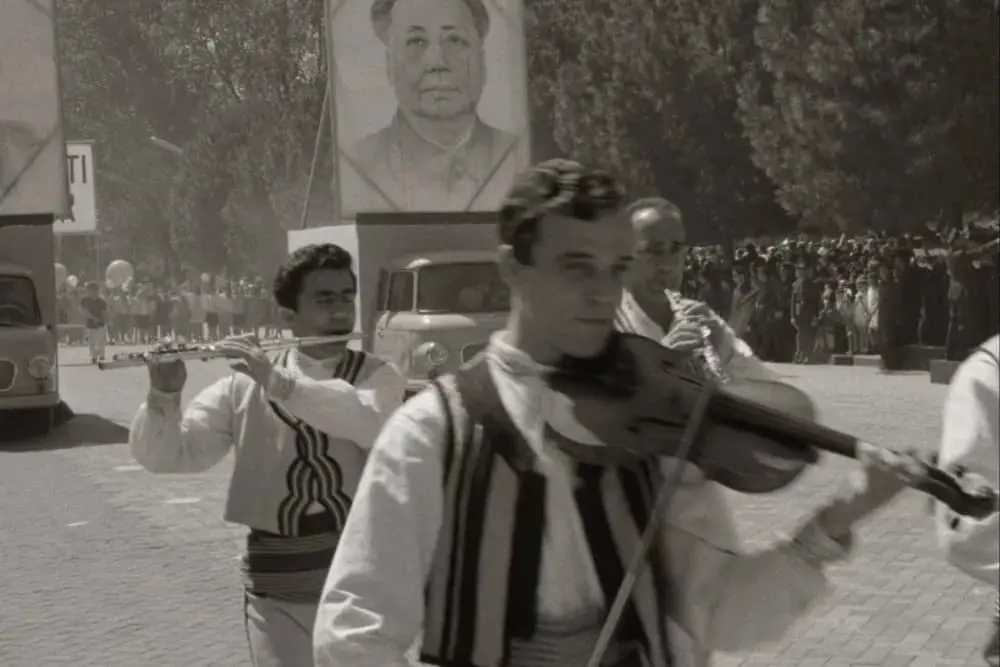
"There was never a manual for the propaganda cameraman, no written rules on how to film a regime. Yet something invisible guided their images. A May Day parade in communist Albania looks strikingly similar to one in Moscow, Bucharest or Sofia at the same time."
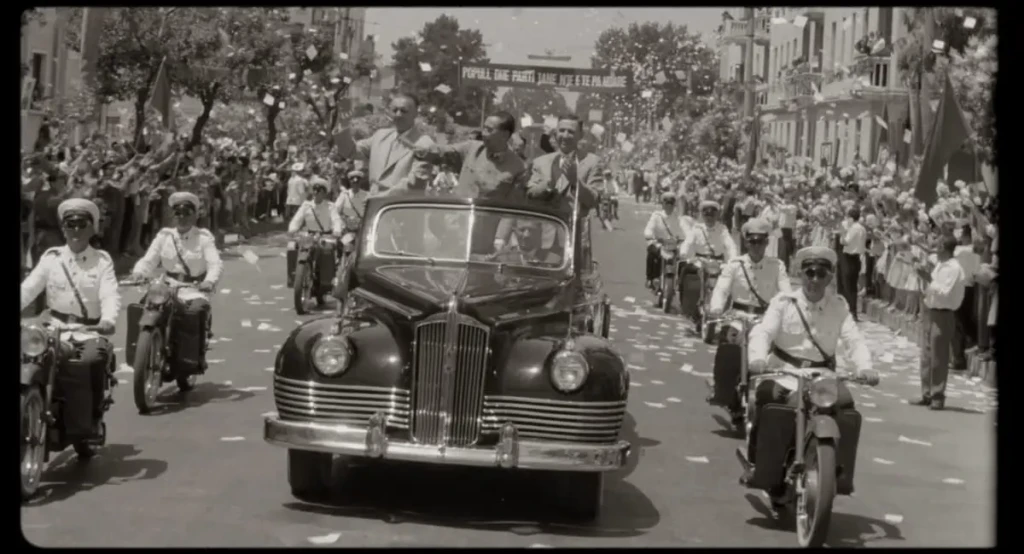
The images of cheering workers and girls in traditional costumes in “A State Film” are strikingly familiar. The film covers the years after World War II, with Albanians urged to “obey and carry out the laws of the government” while honoring the sacrifices of the heroes. At the same time, Hoxha’s loyalty to Stalin and Yugoslav dictator Tito is highlighted.
Huge portraits of the three leaders are carried through endless streets as partisans march with carts, shovels and guns. Hymns to industry are sung, while Hoxha's defensive bunkers are tested to prove their strength against the "forces of Western imperialism".
Dogs and guinea pigs are sacrificed, presumably to test exposure to possible gas attacks. And at every moment there is another patriotic anthem for the villagers to sing.
“It’s not just the cameraman’s technique that creates this similarity,” says sejko. “It’s the Vision Of the world that is presented: always the same choreography of collective joy.”
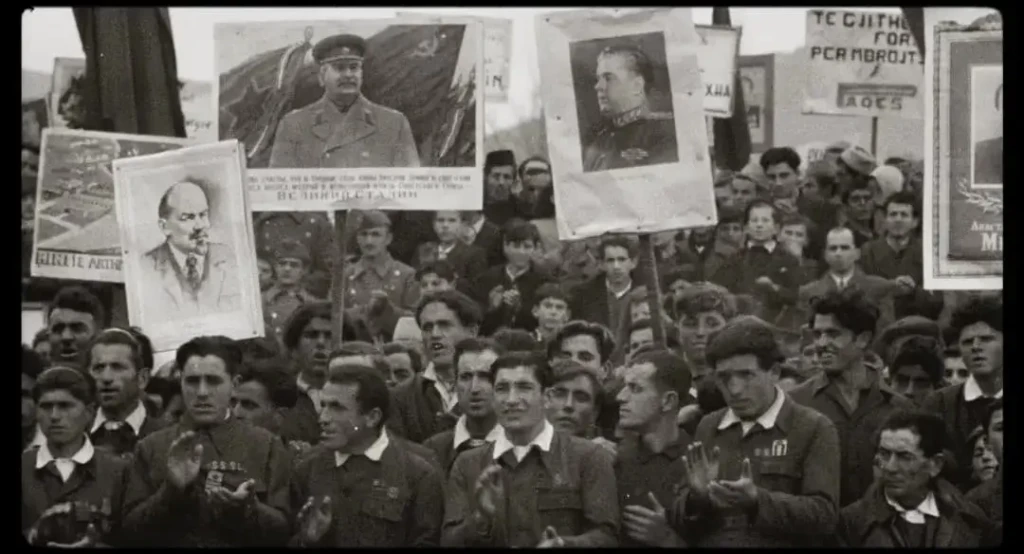
As viewers watch “A State Film,” they realize that the images have been sent in a new way. The original narrative voice has been replaced by the sounds of the wind, the chirping of birds, and footsteps on dirt roads.
"In official propaganda films, the narrator's voice was not descriptive but directive: he told viewers what to think. Replacing it even with a critical voice would be repeating the same mechanism."
"So I removed not only the voice but also the entire original soundtrack, keeping only the actual applause, songs, speeches. I created a new, realistic soundscape with footsteps, whispers, creaks, silences, as if the scenes had been recorded live. This new texture restores the naturalness of the images and opens up a space where sound itself becomes a storytelling tool."
Adding footage from Hoxha's personal archive, showing moments away from the crowd, such as rides in his beloved black Mercedes, creates a stark contrast. These motifs acquire symbolic value and suggest the loneliness and isolation of power.
“A State Film” raises questions about how forms of propaganda have changed and forces uncomfortable realizations about how many of the classic tropes still apply today. The film shows how the archive is not simply a repository of images, but a tool for interpreting and reinterpreting history.
The chilling parade of carefully staged scenes seems to transcend the boundaries of national history, exploring the function of the image in the political space and its ability to create collective memory.