
Its castle is famous throughout the world Silver by name KaliasThe giant, lead-colored fortress, clad in ivy, resists the ravages of time and looms imposingly over the ancient city of GjirokasterIt is said that the city was built by the queen Argyro, after whom it was named Gjirokastra.
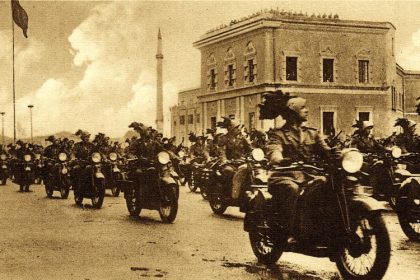
The second version says that it was named so because it is built “around the castle". The Ali Pasha renovated this fortress and used it for his own purposes. Later the king Zogkou he used it as a prison, a means of humiliating his ruthless enemies and especially the Grekidon her Albania. The same thing happened to Italian conqueror.
In the years of the tyrant Hodja, became a symbol of condemnation and hell, became a scarecrow and a fearsome figure. We lived with this nightmare for half a century. This gigantic Good we can well rename it A "cemetery" of living people under the communist regime From 1945-1950 and later.
Many people lived the last days of their lives in this national martyrs our Greek-minded, educated people who dared to fight for the liberation of their country. Betrayed by those inside and outside Gouses, were seized then, in 1945-46. After suffering the most inhuman tortures in the 70 cells of Good, most of them were covered in the gravel of Grechoti in mass graves. Their graves are still unknown today. And many anti-communists Albanians were martyred and exterminated during that period.
Symbol of martyrdom of a people
Those of us who spent part of our youth in the harsh prisons and extermination camps of the tyrannical regime, our minds return many times a day to the lads who had the bad luck to be "hosted" and to bear witness in its dark cells. I will try to convey with my narrative images that confess the tragedy of the enslaved Hellenism her Northern Epirus.
Boureli and Kalias Gjirokaster, the most terrible prisons of Albania with dark cells and many hiding places, which not even the sun had the right to enter, were used for the imprisonment of the "enemies" of the people. This is how the tyrannical regime of the communists was built and demagogically "lit up". Truly a criminal regime, especially for the HellenismBecause what was done against him then Hellenism we can unreservedly call it genocide.
1945 – 1946
THE Kalias filled with chained people Northern Epirus GreeksThe few survivors recount:
The Then 23-year-old T.T. reveals to us, "They brought me tied up from the security detention center Delvinou. He drove the car uphill towards Good. In the darkness of the night, I wandered through the countless steps that looked like a labyrinth. […] We called those who were dying happy and carried them out with a dirty blanket Good, for burial.”
But at the same time, hatred for the newly established communist regime, which had the audacity to call itself "people's", was peaking.
Human curiosity pushed me to explore the entire interior of the dark labyrinth. […] Forty centimeters of space for each person.
One's legs were on the other's stomach. Military patrols were constantly passing over their heads in heavy, spiked boots, their footsteps hitting you in the head like a bullet. This was done for psychological pressure.
The cunning inventors of the “science of torture” had planned everything down to the smallest detail for his opponents. Enver. […] until the day after their arrival”.
The prison guards had to use every means to force the prisoners to sign their guilty pleas. One of them confesses:
"When they transferred me to the room with the 7 windows, I met many of my acquaintances, such as […] Vasilis Christos, Nikolas Stamoulis, Charalambos Lezos, Photo by Lezo, Nasio Lezo etc.”.

The political prisoner B.G., who also came out alive from the Good, tells us names that were tried together. Those who escaped the bullet suffered for many years in the extermination camps.
"I lived with him" Charalambos Pappas, the Aristotle Harbatsis, […] the doctor Grigorion Lambovitis, etc.”.
The teacher S.K. commemorates them Chimaeras: the father-Christos Tzavelas, […] the Thanasis Trichas etc.
The young people K.P. and VAT, 12 and 14 years old at the time, […] Vasilis Pappas etc.
I lived, he says. S.K. and with Albanians anti-communists, educated like: with the Zenel Shehu and Surja Bashari Bey, […] for which they had no documents.
Cell No. 51, near the entrance, “received” prisoners chained hand and foot […] a part of their lives there.
One of the most unusual tortures, […] this until 1948.
The families of the prisoners
Mothers, sisters, women and minor children […] were beaten with clubs.
"You must know that your enemies are people […] you must meet them!!"
After the visitors' insistence, [...] And the man is trash.
These horrific incidents had humiliated and frightened everyone, preventing even the slightest rebellion against the communist regime.
The instructions from the center were mandatory for everyone: Hitlerite and stalinist methods studied by the bloodthirsty agents of the Security and were transmitted all the way to the base.
Communism and Northern Epirotic Hellenism
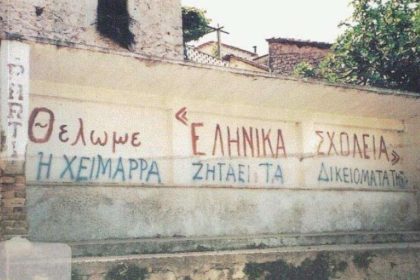
For them Northern Epirus Greeks special orders were coming […] the disappearance and Albanianization of the troublesome Grekidon of the south.
Kotsides and Tziades, Cloths, Klimides etc. […] too late.
Hundreds of families wore black, […] in 1990 alone.
The class war had hung over them like a sword of Damocles for fifty years. There was no mention of human rights in the Albania.
So the Kalias Gjirokaster will remain an infamous symbol of crimes and the most terrible scarecrow in the history of communist rule Albania.
Of Andreas Tsakas