
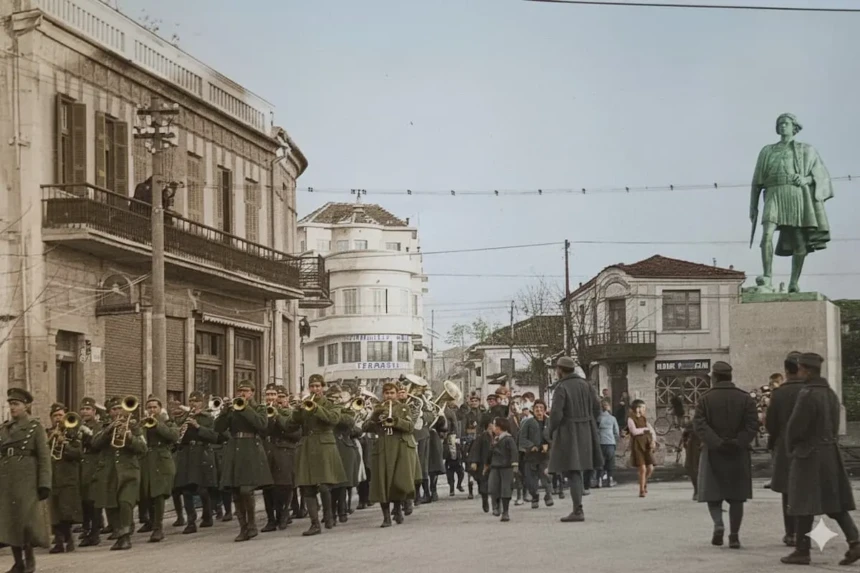
Korçë (the "Paris of the Balkans" as it was aptly called) and the countryside surrounding it, for centuries remains silent in the endless flow of time. The people of Korçë, and the "National Greek Minority" in Albania as a whole, have a clear awareness of their existence and an expressed perception of the difference from the rest of the Albanian layer. The criterion of nationality is not only the language, but the national spirit, the national consciousness. The obscuring of this truth creates deceptions and distorted impressions.
The 19th century finds korçë With a pure greek consciousness, which is defined by education, language, orthodoxy, traditions and timeless greek values. education shows increased dynamics and The schools of korçë become nurseries of greek education, In contrast to the albanian schools, which were never able to develop, due to a lack of students and teachers and, when they managed to function, they functioned thanks to the support of the foreign factor.

The city reached the peak of its prosperity, throughout the period of the Turkish occupation, thanks to the Greeks. It was the center of Greek movement and life. The patriotism of the Korytsians and their ardent desire to establish and operate Greek schools, led them to establish the famous "Lasso", the special, i.e. community fund whose main purpose was the maintenance of the schools and the improvement of their operating conditions.
This patriotism is transfused into the souls of the expatriate Korytsians, who with their offerings and rich support, looked forward to a happy way out of the suffering of the tragedy. In this brief note, we will not refer to the Greek historical course of the Korytsians, their Greek culture and their struggles for freedom. We will limit ourselves to its second liberation during the Greco-Italian War of 1940.
November 22, 1940

28 years after the first liberation of Korçë (1912-1913), when the Greek army pushed back the Italian troops of the Roman pseudo-caesar from continental territory and liberated the Northern Epirote cities one after the other.
On November 22, 1940, units of the Greek army entered the northern Epirus district of Korçë as liberators. The people took to the streets and cheered: “We have taken Korçë.” The liberation of Korçë was the last great success of the Greek army on the northern Epirus front.
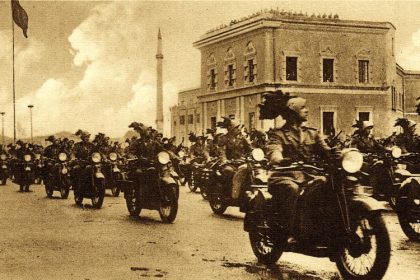
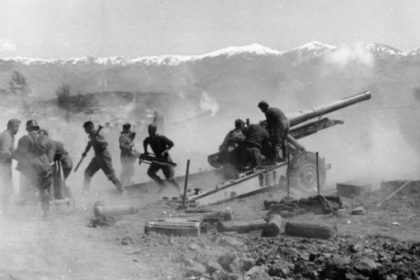
The city was occupied and supported by strong Italian forces (the Trieste – Piedmont – Venice – Aresto division with two battalions of large tunics – with the Versailles battalion and a battalion of Albanians). The fight for its capture lasted eight days and was very bloody. The first officer to enter the city was Ioannis Mergetis. According to his report, the attack of the Greek army began on November 14 by surprise. In the first attack, the first 40 Italians were captured. The attack continued until November 21. An Italian battalion, a mountain surgery and other war material were captured.
At 7:45 a.m. on November 22, Athanasios Paleodimopoulou's battalion entered Korçë and a few minutes later Colonel Ioannis Mergetis entered, who announced with a simple signal to the 9th Division its capture: "At 7.45 our detachment captured Korçë. I. Mergetis – Colonel."
The signal soon reached the Government, which announced to the Greek people the liberation of Korçë. The people of Athens, the entire Hellenism, celebrated its liberation with enthusiasm. The blue and white flag waved at the Korçë Governorate and spread emotion.

The sacrifices, the blood that was shed abundantly, were momentarily forgotten and boundless enthusiasm seized the people. With dithyrambic headlines the newspapers of Athens announced the advance of the Greek army and the liberation of Korçë. P. Palaiologos, envoy of the "Free Step" to the front, sent the following enthusiastic response to the newspaper:
«FRONT OF EPIRUS, November 22 (of our envoy).
The whole of Epirus enthusiastically celebrates the capture of Korçë. Metropolitan Spyridon of Ioannina, apostle of the nations, as he walks around the front, whispers with a broken heart: “God has spoken. These in chariots, these in horses, we in the name of God.” The soldiers embrace each other. With a soul filled with emotion and pride, I gather from wounded officers details of the battles of the day before yesterday and yesterday on the Epirus front. A new Homer is needed to describe today’s epic. We live in an atmosphere of intoxication and delirium.».
The Greek victory made the name of Korça known worldwide and caused waves of enthusiasm among the forces still fighting the Axis. On November 22, British Prime Minister Churchill reported in a telegram: "Hearty congratulations for the victories on the Albanian front, which were sealed with the capture of Korçë. Great enthusiasm is inspired in all of us by this feat of Greek valor against an enemy so superior in numbers and equipment.».
The newspapers of the time were filled with headlines and laudatory comments about the victory at Korçë. The New York Herald Tribune highlighted in its editorial the day after the fall: “The Greek Army proved worthy of its ancestors. It inflicted the first major defeat (of the Axis) that occurred during this great war...». The New York Times continued the celebratory atmosphere for the Greek victory on November 28: «…The Greeks achieved the first real defeat of the Axis land forces... it will be the glory of Modern Greece that it broke the Axis' invincibility..."The Victory also had a huge impact in the Near East.
A telegram from the London Times correspondent spoke of unrest in Syria, the dispelling of concerns in Egypt that feared an Italian invasion, as well as thoughts of combining the Greek victories in Epirus with new blows against the Italians in Libya. In fact, the well-known journalist and military analyst George Eliot commented on November 29 in the New York Herald Tribune on the tragic situation in which the Italian Army had fallen after the retreat and the benefit that the British fleet and air force were securing in the Mediterranean. The following day, in an extensive article, the London Times described the new strategic situation that was being consolidated in the Mediterranean after the Italian retreat.

The following day, in an extensive article, the Times of London described the new strategic situation that was being established in the Mediterranean after the Italian retreat. 46 It is also noteworthy that even in films being shot in Hollywood at that time, reference was made to the Greek victory at Korçë, including Orson Welles’ film, Citizen Kane.



Η εποχή των εθνικισμών τελείωσε ανεπιστρεπτί μετά το τέλος του ΔΠΠ, προτείνω σε εσάς τα παιδιά του Himara.gr να το πάρετε επιτέλους χαμπάρι και να μην χάνετε τσάμπα και βερεσέ τον καιρό σας με βαλκανικούς χαζό εθνικισμούς. Τελείωσε παιδιά, τα σύνορα δεν αλλάζουν και τα γελοία αφηγήματα του παρελθόντος δεν έχουν κανένα βάρος σε έναν νέο κόσμο με μουσουλμάνο δήμαρχο Λονδίνου και Νέας Υόρκης, μετέπειτα με μαθηματική ακριβεια και με Πρόεδρο ΗΠΑ κτλ. Ο δυτικός κόσμος δεν έχει καμία σχέση πλέον με τα αφηγήματα του 1840.