
It is with particular honor and pleasure that I welcome to Athens the Minister of Europe and Foreign Affairs of Albania, Ms. Elisa Spiropali.
Dear Elisa,
We know each other and have collaborated in the past in our previous capacities. I am particularly pleased that one of your first visits abroad after assuming your new duties is to Greece, a fact that demonstrates the importance you attach to good neighborly relations.
Greece and Albania are connected by centuries-old bonds of friendship and cooperation. We recognize, of course, that we have also gone through difficult times and trials.
However, our shared geography, as well as the current geopolitical situation, require us to look ahead. We must work closely to improve our relations.
We firmly believe that where there is a will, there is a way.
That is why we must focus on what unites us for the benefit of stability and prosperity in our region. And to see the future of our bilateral relations with vision.
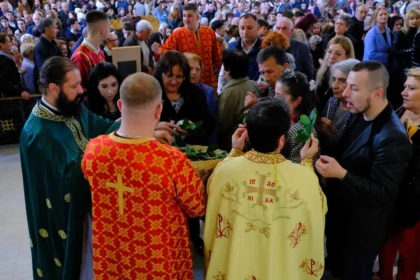
Indeed, the indigenous Greek National Minority in Albania constitutes to this day a bridge of communication and understanding and is the unbroken connecting link between the two peoples.
Also very important in this direction is the contribution of Albanian immigrants who live and thrive in Greece, having demonstrated a very significant degree of functional integration into Greek society.
With the Minister of Foreign Affairs of Albania, we had the opportunity to exchange views on issues of regional and international interest, our cooperation within the framework of NATO and the United Nations, as well as in other international organizations and forums.
One of the main topics that occupied our discussions today was Enlargement, which we all recognize as a geopolitical necessity of the European Union.
As in our recent meeting in Vienna, where we met within the framework of the Group of Friends of the Western Balkans, I supported the importance of giving a new dynamic to the European perspective of the Western Balkans.
Greece, with the Thessaloniki Agenda, has been a pioneer in promoting the idea of integrating the Western Balkans into the European family. 22 years after Thessaloniki, Greece remains a leader in this direction. We are ready, with the Greek Presidency of the Council of the European Union in the second half of 2027 in mind, to take initiatives to accelerate the European path of the Western Balkans.
We are convinced that the integration of the Western Balkans into the European family is the only path to creating an environment of peace and security in a region with a long history of divisions and conflicts.
It will also contribute to overcoming the risks created by illegitimate external interventions, as well as by the resurgence of stereotypical perceptions and outdated nationalist and revisionist discourse, elements which do not contribute to building trust and good neighborly relations.
Greece remains consistent with its declared position of convergence of the Western Balkans towards the European Union, based on its own performance and reforms. We welcome in this regard the progress made by Albania, which led this year to the opening of accession negotiation chapters, where Greece has maintained a truly constructive stance.
In this context, we attach particular importance to the fulfillment of all relevant obligations, especially with regard to the "Fundamental Areas", progress in which determines the overall pace of the negotiations.
Particular care is required to respect, protect and guarantee the rights of the indigenous Greek National Minority, which is a major priority for us, but also overall for the consolidation of the rule of law.
We have already agreed to strengthen our cooperation within the framework of the operation of the land registers for the fastest possible delivery of property titles in areas of interest to the Greek minority.
Honorable Minister,
In our meeting today, we agreed that there is significant scope for quantitative and substantive expansion of an already multifaceted cooperation, especially in areas such as trade, connectivity, energy, investment, cross-border cooperation, tourism, education, training and culture.
Moreover, almost all of the issues that concern the modern world and, in particular, the multiple challenges, including in the fields of security, connectivity, and the climate crisis, transcend national boundaries and require understandings and joint actions at a regional and broader international level – let alone between two countries with a long tradition of coexistence and cooperation in our common geographical space.
Dear Madam Minister, I welcome you again to Athens, I wish you success in your new duties and I look forward to a sincere and beneficial cooperation for the good of our two peoples. Welcome.