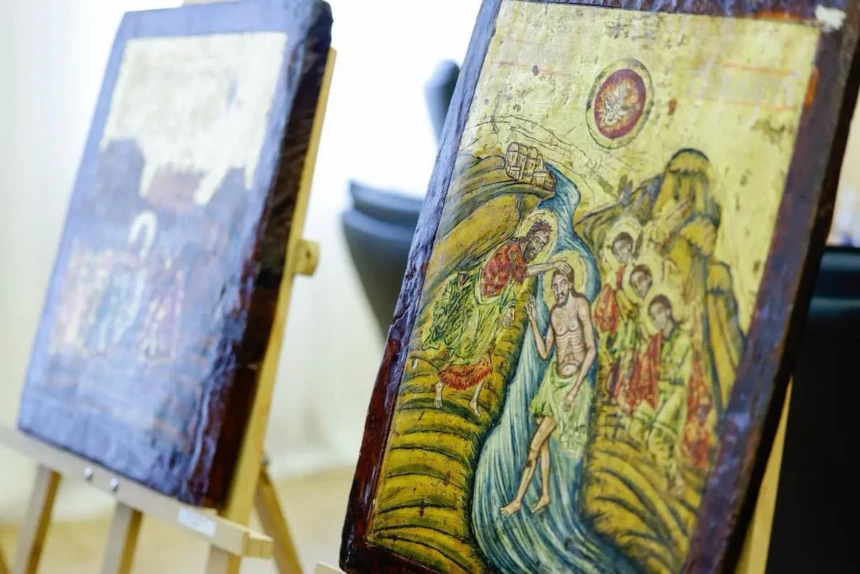
After fourteen years of absence, ten Byzantine icons of high historical and religious value they return to their natural place, closing a long cycle of loss, illegal trafficking and institutional claim. The case is not simply about the recovery of art objects, but the restoration of a piece of collective memory.
The icons, which had been removed from the Church of the Assumption of the Virgin Mary in the village of Lambovo in Stavros, were located as part of a coordinated Police operation, with a key role in recording cultural goods. Their documentation proved to be the crucial tool for their identification and repatriation.
The handover of the icons took place in a particularly symbolic atmosphere, in the presence of the Minister of Tourism, Culture and Sports, Blendi Gonxhja, and the Archbishop of the Autocephalous Orthodox Church of Albania, Ioannis. Both sides highlighted that this is an act that goes beyond the narrow legal framework, touching on issues of historical justice and spiritual continuity.

The Minister stressed that the success of the case confirms the importance of systematically recording cultural heritage, especially in an era when religious relics are often the target of illegal Gangs. he also underlined that cooperation with religious communities will continue, with the aim of identifying other reported losses.
For his part, Archbishop Ioannis focused on the uniqueness of icons, not only as works of art, but as carriers of identity and history. He pointed out that their protection is a shared responsibility of the state and the Church and is directly linked to the country's European cultural heritage.
On the sidelines of the meeting, the restoration and maintenance programs for churches and monasteries that have been designated as cultural monuments were discussed at length, as well as the need for closer coordination between the competent services in the field.
The return of the ten images now works as an example of institutional consistency and cultural awareness, recalling that cultural heritage is not protected only by declarations, but by actions that restore what has been lost and protect what is at risk.