
In the old days in Epirus, the Lights had a special glamour and, according to local tradition, were associated with the disappearance of demons and goblins.
The third "annual" day in the Twelve Days is Epiphany or Lights, which together with the day of "Consecration" and Saint John constitute a three-day celebration of the waters. The eve of Lights is also called Protagiasis.
As the elders remember, with great emotion and nostalgia, on the morning of the eve of Epiphany, the women would clean the house, the yards, and the alleys, so that the priest could pass later.
According to custom, the priest would go through the entire village and bless the residents, all the buildings in the house and the animals. In the past, wherever the priest passed, everyone would give him food.
These were used to help the priest and his family. Of course, each person offered what they had in their home, which was oil, wheat, barley, flour, broad beans, lentils, chickpeas, potatoes, rusks, etc.
Let us consider, however, that productions were not large in those years, and there was almost nothing left over. But the village gave to the priest, and no one reacted to it, they even had it as their pride!
It was to strengthen him, since in those times the priests were not paid by the state. Later they would throw a coin (usually a didrachm, thaler or ten cent) into the pot.
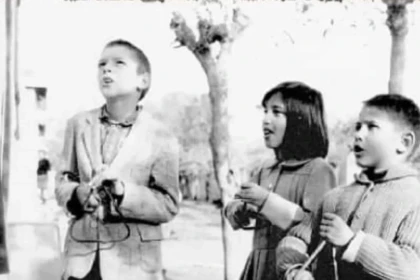
The children sang carols, just like on previous holidays. The children knocked on every door and as soon as it opened, they entered the house without permission, asking: "Shall we meet?" and without waiting for an answer, they began singing.
In Epirus, they sang carols that are also found in other regions of Greece and not adapted to a local form.
Today the lights and lighting
great joy and sanctification.
Down in The jordan river
our lady, the virgin mary, Sits.
Good morning, good evening.
Have a good day, sir, and lady.
He holds an organ, he holds a candle
and he begs St. John.
Saint john the baptist
baptize me too, child of God.
To ascend to the sky
to gather rose and frankincense.
Good morning, good evening,
Have a good day, sir, and lady.
The children's reward was a few drachmas or eggs, whatever the housewife had. And unfortunately, many housewives had neither a drachma nor an egg to give the children and would not open the door to them, not wanting either carols or the children's blessing.
That's why the children would start singing carols at night, and whichever group got there first, because rarely would a housewife allow a second group to sing carols, because she had nothing to give them.
One could say that they were having a race, with one group competing with the other to see who would be the first to sing the carols and get the tip.
On the eve of Epiphany, which is also a fasting day, the housewife would prepare the so-called "fotokolyva". They were boiled from all legumes, broad beans, chickpeas, beans, lentils, etc.
They ate part of it and with another part, unsalted and drained, they fed the animals and threw it at the chickens. But also on the roof of the house, saying:
«Eat wild birds, and stay away from sowing!»
On the day of the feast of the Epiphany, the faithful went to church and received holy water in flasks, jugs, bottles, jugs and pitchers.
When they returned home, all family members symbolically drank three times from the holy water, sprinkled it on the house, animals, fields, and gardens. Whatever was left over was saved for medicine.
They saw holy water as a medicine that would wash away their sins. Thus they showed repentance in action and not in words. Repentance that came from their hearts and cleansed the filth of impiety.
Wherever there was a lake, sea or river, the immersion of the Holy Cross took place. When they returned home, all the family members drank from the water, sprinkled the house, the animals, the fields and the gardens. However, they did this only on the day of the feast.
The next day, neither they nor the priest were allowed to do the same. Whatever was left over was kept as medicine. Tradition was to keep the blessing in their icons (at that time all homes had icons, now very few do).
In fact, the phenomenon is observed: The great blessing, even after years, although it is sealed in a bottle, does not deteriorate, but its water is clean and healthy.
Lights and goblins
The tradition that the goblins who had come to earth were leaving is also associated with the Lights.
This mythological belief of pagan times, to which Christianity gave a spiritual dimension, with evil spirits, which are combated through sanctification, is also connected to the necromancy of Ephyra in ancient Thesprotia, where Ephyra, according to mythology, was the center of the Underworld.
There was, therefore, the perception, which has weakened in recent years, that the souls of the dead returned to earth for a period of time and stayed close to the living, where, trying to have fun, they became annoying with their antics.
Κατά την Τουρκοκρατία, υπό το βάρος της σκλαβιάς, ενισχύθηκαν και συνεχίστηκαν οι δοξασίες γι΄ αυτά τα όντα. Η τυφλή υποταγή των ανθρώπων στη δεισιδαιμονία, βοήθησε να φτάσει ο µύθος των καλικάντζαρων ως τις µέρες µας. Με βάση τη λαϊκή φαντασία , ο καλικάντζαρος κατά τόπους εµφανίζεται µε ανθρώπινη µορφή, τριχωτό δέρµα, άλλοτε τυφλός, άλλοτε µονόφθαλµος, κουτσοπόδαρος, τραγοπόδαρος, ψηλός, λιγνός µε σιδερένια παπούτσια, ξεπλατισµένος, κωµικός πάντα στην εµφάνιση και στην περπατησιά. Πότε δεν κόβει τα νύχια του και είναι πάντα άσχηµος.
Σύµφωνα µε µια παλιά δοξασία στη Θεσπρωτία, αλλά και στην υπόλοιπη Ήπειρο, όποιος γεννηθεί µεταξύ Χριστουγέννων και Αγίου Βασιλείου, µετά το θάνατό του γίνονταν καλικάντζαρος. Αυτό ίσως εξηγεί και γιατί στην Ήπειρο νόμιζαν ότι υπήρχαν σχεδόν σε όλα τα χωριά “καλικάντζαροι”. Οι καλικάντζαροι εµφανίζονται στις γιορτές του δωδεκαηµέρου και έρχονται κάτω από τη γη, όπου κατοικούν τον υπόλοιπο καιρό. Σύµφωνα µε την παράδοση, οι καλικάντζαροι που µισούν τους ανθρώπους, προσπαθούν να κόψουν το δέντρο που στηρίζεται η γη αλλά δεν προλαβαίνουν, γιατί έρχεται ο αγιασµός των Θεοφανείων και έτσι εξαφανίζονται πάλι στα τάρταρα.
Unknown incident of Epiphany during the Occupation

The Occupation in Thesprotia was triple: Germans, Italians and "Tsami" had created an unbearable climate of oppression. Red-hot iron dominated everywhere. The loss of life and misery were the tragic reality.
German soldiers had surrounded the church of Igoumenitsa since the eve, at that time it was a small building with the cemetery in the courtyard, so that no one, not even the priest, would dare to come for the celebration of the Lights.
The enslaved inhabitants, who were impatiently awaiting the Epiphany, locked themselves in their homes.
However, they wanted to draw strength from the holy water, to endure hardships and to feel that the Baptism of the Lord in the Jordan River would mean their own rebaptism and rebirth in the waters of freedom.
They based their present and future on Christ and His Truth.
The ban on the celebration of the Lights came as a retaliation after a sabotage against the occupiers, which, as it later turned out, was a plot by the "Tsami"...
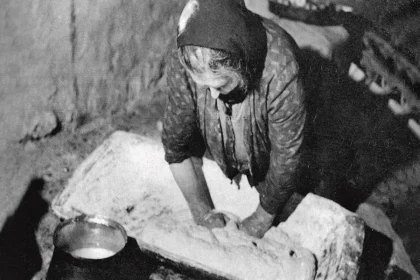
The priest, with patriotic grandeur, made the decision: At midnight, he gathered a few believers in a house, poured water into a pot, and performed the great blessing, while a small candle burned low.
Immediately afterwards, defying any enemy patrol to notice him, he descended, like a shadow, into the sea and immersed the cross, softly chanting: "In the Jordan, you were baptized, O Lord...".
In the morning, the blessing was shared from person to person in the few, compared to now, houses of Igoumenitsa, while the occupying forces were left with the impression that they had prevented the celebration.
This fact shows that people, no matter how difficult the circumstances, no matter how much life seems like an endless Lamentation, seek God's grace.
Souls felt and continue to feel him as Savior and Redeemer in difficult and humanly hopeless years.