When you research the history of heroes, you truly feel proud to be Greek. And when you reach the top of Old Himara, you understand that those who lived and worked there loved their country very much. Freedom, a concept that in such places—like Himara—is identified with Hellenism.
In the years that we will be referring to, the Greek borders in Epirus were up to the Prefecture of Artis. The Greek government, aiming at the expansion and penetration of troops in Northern Epirus (B.H.) based on ethnological criteria that assumed that they would reach the northwestern borders of the state, selected the officers Spyromilios, Tsodo and Mano, whom he would send to the continental front. They, as leaders of Scout corps, would prepare the advance of the troops and make it easier.
In early October, the gendarmerie major was sent to Corfu Spyromilios, who came from Himara, with orders from the Greek government to organize volunteer corps in the province of Himara, to ensure the equipment of its Christian inhabitants and to come to an understanding with Albanian beys for the voluntary submission of the Albanian population to the Greek army.
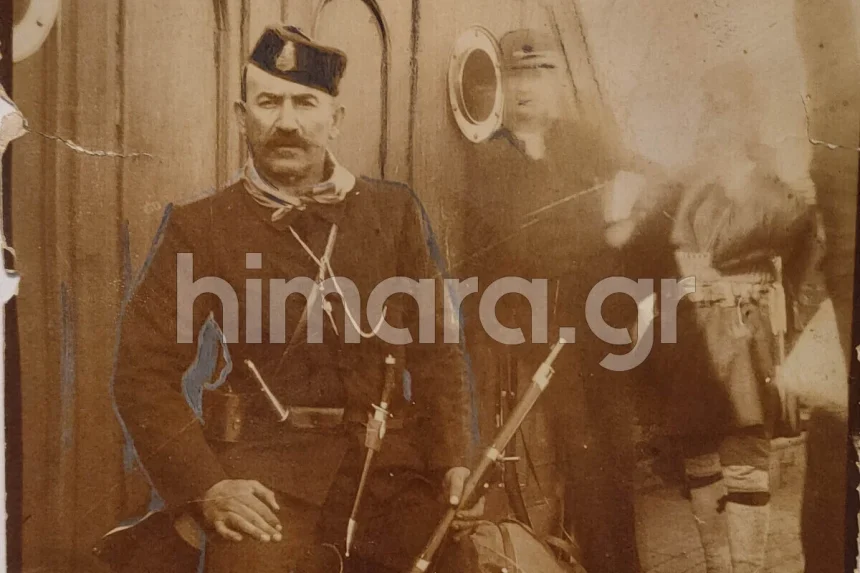
THE Spyromilios he was an experienced, capable and courageous officer. From a young age, he was burning with the desire to liberate his homeland. A descendant of the historical family of Himara — the first ancestor was a fighter in 1821 and was called Spyros Milios (Michael) — later the entire family kept this surname, an honorific, as some reached high positions and fought for the liberation of Greece.

The outbreak of the Balkan Wars and the developments on the continental front constituted the best opportunity for an officer who had already been tested in the Macedonian Struggle.
From 1903–1905 he served at the Greek consulate in Thessaloniki under the pseudonym "Souris" under the consul Koromilas. Moving around the Monastir area, he gathered information about the Turkish and Bulgarian forces, repelling Bulgarian and Romanian propaganda in Macedonia and organizing information for the creation of guerrilla forces (Macedonomachoi). He was one of the founders of the "Macedonian Committee".
In 1905 (April) he went up to Macedonia as the head of a Macedonian Fighters' corps of 35 armed men. In the Macedonian Struggle he operated under the pseudonym "Boas". Based on the plan of K. Mazarakis he successfully confronted the Bulgarian komitatzides and Turkish detachments in the area between Bachovo and Morichovo. He was the inspirer and soul of the "Epirotic Society of Athens", which prepared in every way the struggle for liberation throughout Epirus (1908).

Before the Greek government begins negotiations with Turkey, it is considered appropriate to proceed with the Spyromilios in the liberation of Himara, so that the claims to the north would already have been made known to the Turks before the negotiations.
On November 3, 1912, following an order from the commander of the Epirus army corps, 200 Cretan volunteers boarded the ship "Acheloos" from Kopraina and headed for Corfu, where in the early hours of November 5, the volunteer corps also boarded. Spyromiliou (including 17 Sailors). the Disembarkation of the units took place At 7:30 the same day In Spilaia —the center Of himara and its port—.
The Cretan detachment headed to the southern sector of the city, while the Himarian detachment moved to the northern sector and reached the command post, where it was fired upon by the Turkish defenders. A skirmish ensued and the Turks surrendered. Immediately afterwards, the head of the corps Spyromilios he proclaimed Himara "free and an integral part of the one and indivisible great Greek Fatherland" and raised the Greek flag at the headquarters, under the indescribable enthusiasm of the people of Himara. An atmosphere of embrace and joy prevailed in all the villages.

The proclamation still exists. It finally calls on the people of Himariots to stand under the sacred flag of the homeland and bravely defend it. Freedom against every enemy.
At the same time, the Spyromilios sends two corps of Cretans (100 men) to the mountain pass of Logaras with the aim of securing the province from a hostile threat coming from VloraThe leaders of the corps were Galerius and Polyxynges.
Despite the continuous efforts of all of them and with the liberation of Korçë (7-12-1912), with the Conference of Ambassadors in London, the Great Powers, with the well-known London Protocol, recognized Albania as independent under an international commission and temporary borders, which were subsequently finalized, ignoring Greek rights, with the well-known Florence Protocol (17-12-1913).
Στις 21-2-1913 απελευθερώνονται τα Ιωάννινα. Η γαλανόλευκη θα κυματίσει στις 4-3-1913 στους Αγίους Σαράντα, αμέσως μετά στο Αργυρόκαστρο, την Πρεμετή και το Τεπελένι. Η Χιμάρα, που άνοιξε το δρόμο για την ελευθερία και κράτησε ηρωικά αυτήν, δέχεται ενισχύσεις του ελληνικού στρατού. Ένας λόχος εγκαθίσταται στους Δρυμάδες για να ελέγχει το πέρασμα της Παλούσσας. Επικεφαλής του ο ταγματάρχης Κωτούλας. Τα πολεμικά πλοία «Αλφειός» και «Πηνειός» κανονιοβολούν τις αντίπαλες θέσεις στο Λογκάρα. Η Χιμάρα ζει το όνειρο αιώνων. Όμως τα σχέδια των Μεγάλων Δυνάμεων είναι διαφορετικά.
What follows is the continuation: the declaration of the autonomy of B.H. and the Protocol of Corfu (1914). His opposition to autonomy is expressed by Spyromilios και οι άλλοι δύο εκπρόσωποι της επαρχίας Χιμάρας και, διαβλέποντας νέα υποδούλωση, με νέα προκήρυξη την 21η Ιουλίου 1914 κηρύσσει ένωση με την Ελλάδα και υψώνει πάλι την ελληνική σημαία στη Χιμάρα, δηλώνοντας ότι η Χιμάρα, εμμένουσα στην απόφαση του Α’ Ηπειρωτικού εν Αργυροκάστρω Συνεδρίου για ένωση με την Ελλάδα, υπερασπίζεται αυτό το αίτημα και, προκειμένου να μην καταστραφεί, επιβάλλεται να παραμείνει υπό τη Σημαία της Μητρός Ελλάδος. Αποχωρεί από τη διασκέψη ζητοκραυγάζοντας: «Ένωσις ή θάνατος».

THE Spyromilios, despite all his contributions, he did not receive the recognition he deserves — neither from the official state nor from the point of view of bibliography. His memory will always mean the strengths of Hellenism, the incompromise, our cultural superiority. His name will be tied to the struggle for freedom and fair, with the refusal of compromises and humiliations.
Athanasios Kormalis