

OR baronial family Sina, a greek dynasty originating from moschopolis, constitutes One of the most characteristic examples of the greek presence in The balkans and Central Europe during the 18th and 19th centuries.
Although some Albanian sources have attempted to present it as an "Albanian" family, historical evidence, tradition, language, cultural consciousness and its overall work clearly demonstrate that it is a Greek/Greek-Vlach family, closely connected to the Greek world and to the greater center of education and culture Of hellenism, Moschopolis.
This reality fully explains the fact that almost every charitable act as well as every cultural and educational initiative of the family was directed Towards greece and greek institutions.
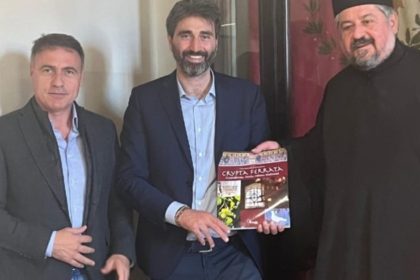
A monument dedicated to the Sina family was recently inaugurated in the center of Moschopolis, thanks to the cooperation of the Hungarian Embassy in Albania and the Hungarian community in Tseret.
During the ceremony, the Hungarian Ambassador to Albania, Martina Kasnik, emphasized that Simon Sinas was a visionary philanthropist, who with his works left an indelible mark on Hungary and beyond, recalling his significant contribution to the construction of the emblematic bridge that connected Buda with Pest.
The Sina family abandoned Moschopolis in 1769, after the city was captured, looted and burned by Turko-Albanians from Cologne; a tragic event that completely destroyed the previously thriving center of Hellenism and forced the Greek/Hellenic-Vlach population to disperse to Thessaloniki, Thessaly, Vienna, Buda and other cities.
After these events, the family settled first in Vienna and then in Austria-Hungary, where it received the baronial title "von Sina, Hodosi und Kizdia" and evolved into one of the most powerful banking families in the Habsburg Empire.
Baron George Sinas and his son, Simon Sinas, played a decisive role in the Hungarian economy, in the academic life of Austria and, above all, in the establishment of important Greek institutions.
They were the main financiers of the construction of the Széchenyi Chain Bridge in Budapest, while the coat of arms and inscriptions testifying to their contribution are still preserved on the monument itself today.
Their major works in Greece clearly demonstrate their Greek identity: the family financed the construction of the National Observatory of Athens, one of the most important scientific institutions of the modern Greek state, and contributed decisively to the construction of the Academy of Athens, one of the most imposing symbols of Greek culture and education.
Beyond these major projects, the Sina family financially supported schools, churches, and Greek Orthodox communities in many areas of the Balkans and the Ottoman Empire, a fact that further confirms that their work was closely linked not to Albania, but to Hellenism, with which the family members fully identified.
Family tragedies marked the end of the dynasty in its male line, as Simon Sina's only son died very young and several of the daughters also died prematurely; however, women from their lineage still live today in Greek and German aristocratic families.
The history of the Sina family, born in Moschopolis but shaped and elevated in the Greek and Austro-Hungarian space, is a testament to a strong Greek cultural and identity heritage, which is still honored today in Greece, Hungary and Austria.
The monument erected in moschopolis does Not simply honor a wealthy family of the time, but a greek dynasty that from its roots in moschopolis Rose to the upper intellectual and economic strata of Europe.
The event was also honored with his presence by the Consul General of Greece in Korçë, Mr. Bouzias Asterios.
Fortunately, the historical truth is being restored by others, because if we relied on the Greek governments and the majority of the representatives they send, what the Hungarians did today would never have happened.