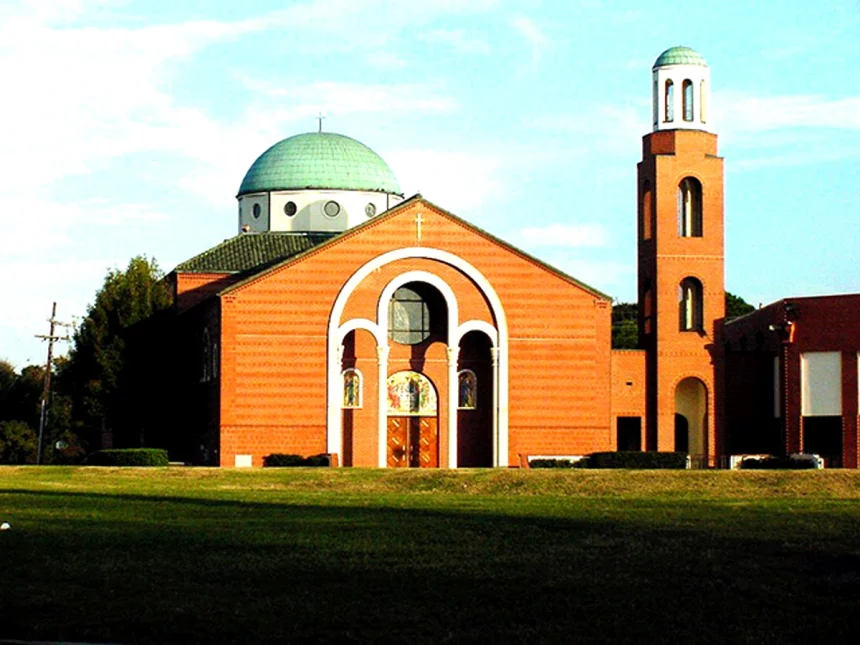
New Orleans is a unique blend of the Old and New Worlds. It is no wonder that a people as active and complex as the Greeks felt drawn to this place.
It is located near the mouth of the Mississippi River, which runs through a huge part of North America, and its geographical location has played a decisive role in American history.
It is often called the most European city in the United States, but at the same time it carries strong American, Southern, Latino, and African elements.
Its history is complex, heavy and layered, reminiscent of the Old Continent. In a country where much is new and homogenized, here one finds richness and depth, in trade, gastronomy, culture and music.
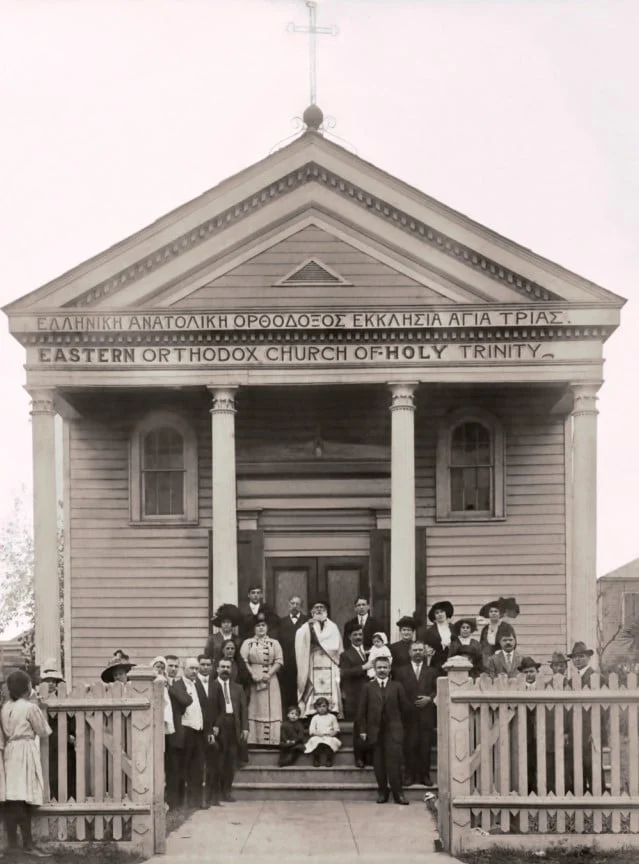
The first Orthodox Church in the United States was founded here in 1864 and completed in 1866, by Greek merchants and other Orthodox residents. The parish included Greeks, Syrians, Serbs, and other Slavic Orthodox.
Driving with Magdalene Spyrou Maag, the archivist at Holy Trinity, to the city's new Greek church, instead of stopping there, we headed to a swamp that leads to Lake Pontchartrain. She wanted to start the story from the beginning, with the first Greek residents.
The first confirmed Greek in New Orleans was Miguel Dragon, a resident of the Venetian Islands, who arrived in the late 18th century, at a point where ruins of an old fort still stand today. His daughter married in 1799 the Hydra native Andreas Demetriou, who is considered the third Greek in the city. Demetriou later fought alongside General Andrew Jackson at the Battle of New Orleans. These early Greeks had arrived before New Orleans was incorporated into the United States.
The US purchased New Orleans and Louisiana from Napoleonic France in 1803. The economy flourished, especially due to the harsh and inhumane slave farming in the American South.
Greek merchants, mainly from islands or kinship networks that had already developed in the Mediterranean and Europe, saw a strategic opportunity in this city. In contrast to the migratory wave of poor farmers that came a century later, they were educated, wealthy, and part of an active Greek commercial diaspora, with a presence in cities such as Odessa, Marseilles, Livorno, Vienna, Venice, Trieste, Alexandria, and London.
In the early 1850s, more Greek merchants began to arrive. The port was a center of trade – mainly cotton from the plantations of Mississippi, Louisiana, and Alabama, but also products from the industrially developing American Interior.
The Greeks had the right contacts and navigational know-how – many navigators on the lower Danube were Greek – and they managed to prosper. Families such as the Rallis, Botassis and Benakis opened branches in the city.
Shortly before the American Civil War, several hundred Orthodox Christians – Mostly Greeks – lived in The city. as in many other diaspora communities, the first discussions about establishing a church began here.
Nikolaos Benakis, Originally From chios, arrived in new Orleans In 1850 And soon gained power in the cotton Trade. In 1854 he became Consul Of greece. together With Konstantinos kililis from Asia Minor and michael Draskovic From herzegovina, he Founded the church of the Holy Trinity in 1866.
Initially it was under the Synod of Greece, but by 1880 it was placed under the Ecumenical Patriarchate. The service was held in Greek, but also in Slavonic and Arabic, so as to serve the entire Orthodox community.
This spirit of multilingualism and multiculturalism was common in diaspora communities. In Trieste, for example, the church of St. Nicholas served in Greek and Serbian until a separate church for the Serbs was established.
It also reflected the Roman identity shared by many Orthodox in the former Ottoman Empire. The 1901 statute of the Holy Trinity explicitly stipulated that the liturgy be celebrated in Greek, Slavonic, and Arabic.
The original church was wooden, with Greek columns and a simple roof. Its form closely resembled the local churches of the American South. Although small, it was the epicenter of a community with a Greek soul and cosmopolitan character.
New Orleans merchants linked their operations with Alexandria, Egypt, investing in Egyptian cotton. Many of the first cotton gins in Egypt were Greeks from New Orleans.
The community remained small and multinational. Father Misael from Plovdiv, Bulgaria, continued its work, despite the death of important benefactors, such as Benakis.
The Holy Trinity archive preserves valuable books, some of them written in Old Bulgarian, before the Bulgarian language was officially established. Other works include Greek liturgical books from Venice, grammars from Smyrna, and commercial registers from 1847, with handwritten notes by Benakis.
The current Greek community in New Orleans is largely descended from the large immigration flows of the late 19th and early 20th centuries. However, there are also descendants of sailors, mainly from Chios, who arrived after World War II.
The elegance and nobility of this community reflect a deep cultural heritage, similar to that of the old greek communities of Europe.
The current descendants of this first Greek community are a continuation of a global commercial and maritime diaspora, based on knowledge, courage, faith in their family and region, and a spirit of cosmopolitanism and solidarity.
These values made Greece a leading maritime power and contributed decisively to the success of the Greek diaspora. Preserving this history is valuable, as it can inspire and guide us for the present and the future.