
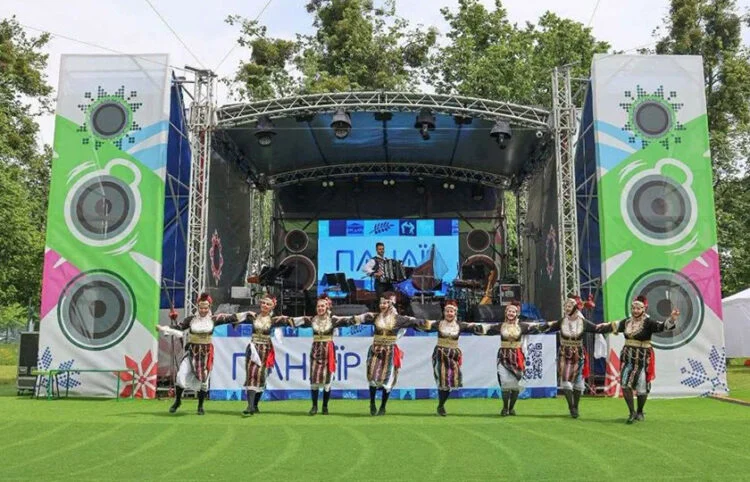
An important institutional recognition for the Hellenism of Ukraine comes to enshrine a centuries-old tradition. "Panoir", the Greek festival that followed the communities from Crimea to the Sea of Azov and continues even in the conditions of war, has been included in the National Register of Intangible Cultural Heritage of Ukraine.
The decision was made by the Ukrainian Ministry of Culture, following a proposal by the Federation of Greek Associations of Ukraine. In the official record, the custom appears as “Панаїр” and is described as a “celebration tradition of the Greeks of Ukraine.”

Behind the recognition lies a historical path that begins in the late 18th century. During the movement of Greek populations from Crimea to the northern shores of the Sea of Azov, families brought with them their religious faith, linguistic traditions, music and customs. Panour took root in the Greek communities around Mariupol and evolved into a meeting point for entire villages.
The celebration was usually associated with the patron saint of each community. The church service and litany were accompanied by a common meal, traditional dances and games, creating an institution that was passed down from generation to generation.
The Russian invasion of 2022 and the displacement of thousands of people from the historical centers of Hellenism in the Sea of Azov dramatically changed the conditions, but not the will of the communities to continue the tradition.
In May 2024, About 3,000 Greeks Gathered in kiev For the panour, Many of whom had been forced to flee their cities and villages. the event was Repeated in the ukrainian capital in may 2026, while In september the Festival was held for the first time in lviv, Where greeks from mariupol And other regions Of the azov sea have Settled.
To achieve official recognition, an almost three-month documentation effort was preceded, in which 35 Greek associations participated. Testimonies, memories and historical evidence were collected from different generations, even from members of the communities that are currently outside Ukraine.
The inclusion of Panour in the national list now creates an institutional framework for its preservation and continuation. For the Greeks of Ukraine, it takes on even greater significance, as a tradition that was born and maintained for centuries in the historical Greek communities is officially recognized at a time when a large part of their population is far from their ancestral homes.
Panour thus continues to unite people who were scattered by the war, keeping memory, tradition and Greek identity alive in Ukraine.


Αυτή η κίνηση υπογραμμίζει την ιστορική συνέχεια του στοιχείου μας. Μια σημαντική χειρονομία που ενισχύει τους δεσμούς και την ελληνική παρουσία στις τρέχουσες συγκυρίες.
καλό αυτό! οι παραδόσεις μας κρατούν δυνατούς ακόμα και σε δύσκολες εποχές. δείχνει συνέχεια και ελπίδα.