

The history of Greek immigration to the United States is not limited to New York, Chicago, and Boston. Since the late 19th century, thousands of Greeks have settled in smaller American cities, establishing businesses, founding churches and schools, and forming organized communities, many of which have changed radically over the decades.
Seeking work, the first immigrants found themselves in the mines of Utah and Colorado, in the factories of Pennsylvania, in the textile mills of Massachusetts, and on the railroads of the American West. In several areas, entire Greek neighborhoods, known as “Greek Towns,” developed, with intense commercial, social, and religious activity.

In Carlisle, Pennsylvania, a community of approximately 45 Greek families was created, while in Newport, New Hampshire, immigrants worked mainly in shoe factories and small businesses, establishing a Greek school and a Greek Orthodox church.
In Indianapolis, where the 1900 census recorded only 29 Greeks, the community grew rapidly and in 1910 was organized around the parish of Holy Trinity. A similar course was followed by Greek communities in industrial and railroad cities in the United States, where economic activity formed the basis for the creation of associations and religious institutions.
Lowell, Massachusetts, holds a special place in the history of the Greek Diaspora. From less than 100 Greeks in 1890, the city evolved into one of the most important centers of Hellenism in the United States, acquiring the third largest Greek population in the country, after New York and Chicago. There was a Greek school, churches and, from 1913, a Greek consulate.
The presence of greeks in salt Lake city, Utah, Was Also impressive. By 1916, the Greek quarter had 116 greek-owned Businesses, while another 78 operated near The city center. restaurants, coffee shops, grocery Stores, barber shops, and commercial stores formed the heart of a particularly active community.
In Denver, Colorado and Cheyenne, Wyoming, Greeks were associated with the development of mining, railroads, and commerce. Over the years, however, the movement of families to the suburbs, the closure of industrial facilities, and economic changes led to the gradual shrinkage of the old Greek neighborhoods.
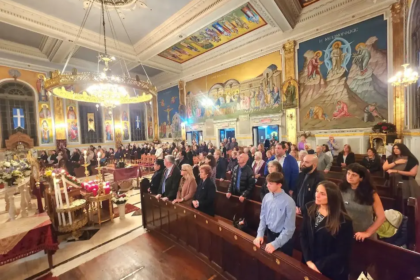
Today, in many of these cities, the Greek presence is maintained mainly through parishes, associations, historical archives, and younger generations of the diaspora. The neighborhoods may have lost their original character, but their history remains an important chapter of Greek immigration and the contribution of Hellenism to the shaping of American society.



ρε φίλε, αυτό είναι κάπως θλιβερό, ε; να χάνονται τα ίχνη τόσων ανθρώπων. κρίμα!