
An ancient color, purple, was considered the most expensive dye material in the ancient world and was more valuable than gold in Ancient Greece, Rome, and Byzantium.
This color was produced by extracting dye from sea snails of the myrtle species and since antiquity has been associated with power and high social status.

Its creation is usually attributed to the Phoenicians, the inhabitants of what is now Lebanon, who founded cities such as Byblos, Sidon, Tyre and Beirut. In fact, the name "Tyrian purple" comes from the ancient city of Tyre, one of the oldest continuously inhabited cities in the Mediterranean and the world.
Others argue that archaeological and epigraphic evidence from the Aegean indicates that "royal purple" was first produced in Crete. Robert R. Stieglitz, writing in the journal Biblical Archaeologist, argued that before 1750 BC, the Minoans in Crete, as well as the inhabitants of Minoan islands such as Kythera, had already developed a purple industry, which then spread throughout the eastern Mediterranean.
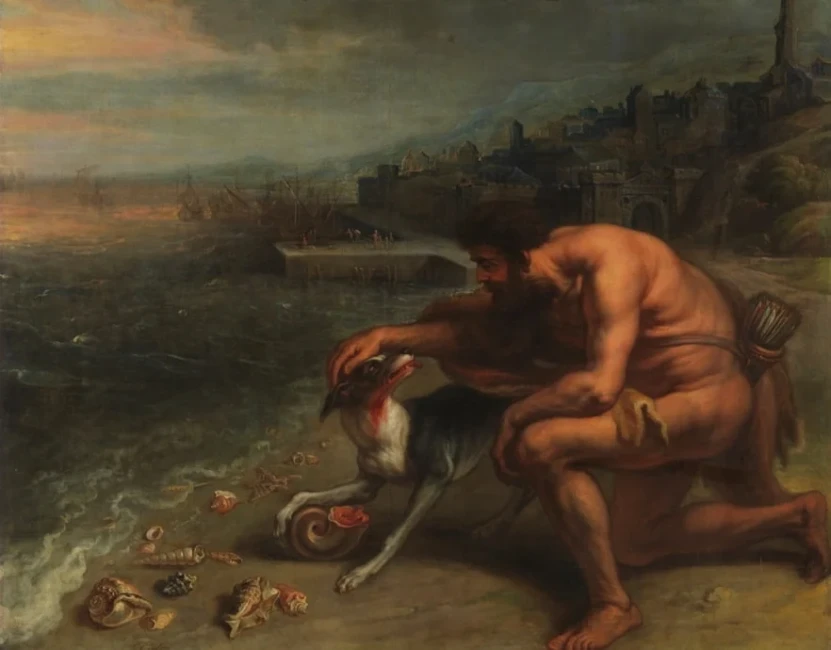
Greek tradition tells a different story: the demigod Hercules, while walking along a beach with his dog to visit a nymph, saw the dog bite a snail and fill its mouth with purple paint. When the nymph saw the color, she asked for a cloak in the same color.
Regardless of who first created it, the fact is that to dye a small piece of fabric, tens of thousands of myrtle glands were needed, which were collected, dried, and boiled.
Unlike other dye materials, Tyrian purple not only did not fade, but its color became more intense with time and use – a miraculous characteristic that justified its exorbitant price, which exceeded the value of gold.
First, the snails had to be collected. According to the Roman writer Pliny the Elder, thousands of snails were needed to produce one ounce of dye. The glands were then removed and placed in lead containers filled with seawater. The containers were slowly heated for about ten days, until the mixture took on a reddish-purple color.
The process was long and extremely unpleasant due to the strong odor. Therefore, the workshops producing Tyrian purple were usually located far from the cities. Its intense color and durability made it sought after, and it was associated with royalty, aristocracy, and prestige. It was mainly used for royal garments, ceremonial robes, and objects of high value.
Its use was often regulated by luxury laws, which determined who was allowed to wear it. In Ancient Rome, purple was associated with imperial worship and was used in ceremonial robes of emperors and high priests.
The use of Tyrian purple in religious and ritual ceremonies strengthened its connection with the divine, adding to its mystical allure.
Although its traditional production from myrtle is no longer widely practiced due to its high cost and environmental impact, there are now synthetic versions of the dye, produced by chemical methods. These synthetic dyes are much more economical and do not require the collection of snails.
However, there are still people who insist on using traditional methods. In 2022, Reuters reported that a Tunisian, Mouhamad Ghassen Nouira, was creating paint from sea snails, inspired by a school project.
Nouira works in a small workshop in his garden, applying ancient techniques to produce Tyrian purple, which he sells online for about $2,500 per gram. Although he initially faced criticism for his hobby, his successes eventually won him recognition and support from those around him. “The criticism turned into encouragement, and that pushed me to keep going,” he said.




re pou na to fantasto oti mia boya itan mia tetoia aksoxyprh fasi den to exo ksanakousei
Ti mas lete tora gia afta? Mono skopia itan na pianoune lefta apo tous kaimenous. Etsi kanoune panta.
kala den to pisteuo ti pragma htan ayto to xroma kala exei na ginei xamos gia to pos to evriskan
ρε φίλε, το μωβ, να είναι πιο ακριβό κι απ’ τα λεφτά; σοβαρά τώρα; τι τέλος πάντων είχε αυτό το πράγμα;
δηλαδή υπήρχε μια απόχρωση που ήταν τέρμα πιο ακριβή κι απ’ το μέταλλο; αυτό δεν το ‘ξερα.
Αρχαίο βαφή… τρελές μπαρούφες! Πάλι οι γνωστοί με τα σαληγκάρια έβγαζαν τα χρισά τους, ε; Τίποτα καινούργιο.
ρε φίλε, πορφύρα λες; από σαλιγκάρια έβγαζαν τέτοια μπογιά; και ήταν πιο ακριβή κι απ’ το χρυσάφι;
Μια βαφή από σαλιγκάρια; Ναι, καλά. Σιγά μη μου πεις ότι ήταν και πιο ακριβή από το πολύτιμο μέταλλο.
κοίτα να δεις τι μάθαινες! ποιος να το φανταζόταν ότι ένα τέτοιο υλικό θα ήταν τόσο ακριβό. ενδιαφέρον.
Πορφύρα, λέει. Οι ‘πλουσιοι’ είχαν βρει και τότε τροπο να ξεχωρίζουν. Μας δουλεύουν ολοι, από την αρχαιότητα.