

The Pyrrhichus was an ancient Greek war dance, believed to have originated with the mythical Kouretes. According to legend, they danced and beat their shields to cover the crying of the newborn Zeus, protecting him from Cronus, who devoured his children to prevent the prophecy that one of his descendants would overthrow him.
Ο πολεμικός αυτός χορός επιβίωσε μέσα στους αιώνες και συνδέεται με τη μυθολογία, αλλά και με έναν συγκεκριμένο χορό των Ποντίων, που διατηρείται μέχρι σήμερα. Αναφορές στον Πυρρίχιο βρίσκονται σε κείμενα του Ησίοδου και του Ομήρου. Σύμφωνα με τη Θεογονία, ο Κρόνος, ύστερα από προτροπή της Γαίας, ανέτρεψε τον πατέρα του, Ουρανό, και έγινε κυρίαρχος των θεών. Για να αποτρέψει την προφητεία που προέβλεπε ότι θα τον ανέτρεπε ένας από τους γιους του, κατάπινε τα παιδιά του. Η Ρέα, όμως, κατάφερε να σώσει τον Δία, κρύβοντάς τον σε ένα σπήλαιο στην Κρήτη, όπου οι Κουρήτες χόρευαν τον Πυρρίχιο για να καλύψουν το κλάμα του.

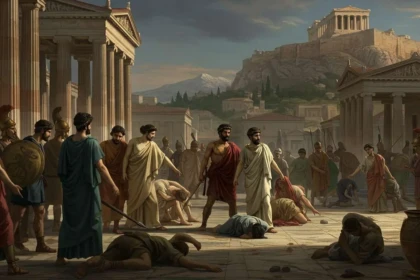
Dance was particularly important in ancient Greece and was part of military training. Aristotle and Homer describe the Pyrrhic dance as a dance with weapons, which included rapid turns, leaps, falls, and movements of attack and defense. Homer mentions that Achilles danced the Pyrrhic dance around the pyre of Patroclus.
Achilles' son, Pyrrhus or Neoptolemus, according to Strabo, danced the Pyrrhic dance after killing Eurypylus, leader of the Hittites who were helping the Trojans. Plato considered the dance a divine gift and distinguished it into two types: peaceful and warlike.
The Pyrrhichus was danced in Athens at the Panathenaic Games and by the Spartans in battle. Xenophon reports that in 400 BC the inhabitants of Kerasounta organized a festival where they danced the Pyrrhichus. In Sparta, the dance was part of the training of young warriors, who, after practicing with weapons, danced to the accompaniment of a flute.
In Pontus, the Pyrrhic dance was preserved as the Serra dance. The writer Konstantinos Papamichalopoulos, describing it, mentioned the dynamics of the movements, the intensity, the voices and the emotions transmitted to the spectators. This dance, although it has evolved over the years, remains one of the most authentic forms of the ancient Pyrrhic dance, preserving its martial spirit and moving those who watch it.

Μιλάμε για heavy metal πριν το heavy metal. Οι Κουρήτες είχαν τρελό ρυθμό για να σώσουν τον Δία. Props σε αυτούς.