
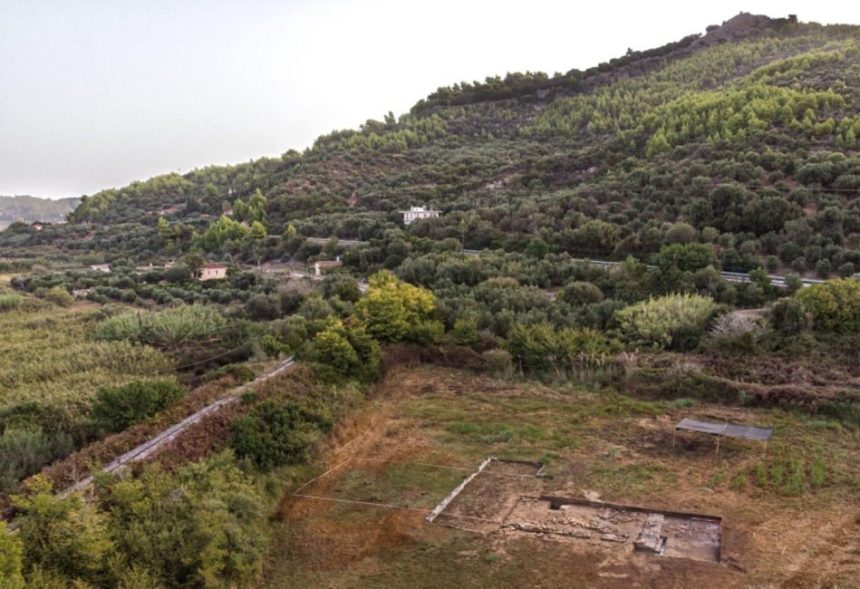
Recent excavations at the relocated temple of Poseidon in Samiko, Elis, have revealed that the building is larger than archaeologists initially assumed.
The centuries-lost Temple of Poseidon in the Peloponnese, an important religious center of antiquity, was rediscovered in 2022, thanks to a collaboration between the Ephorate of Antiquities of Elis and the Austrian Archaeological Institute of the Austrian Academy of Sciences, under the direction of Dr. Birgitta Eder and Dr. Erofilis Kolia.
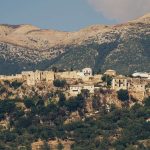
For more than a hundred years, archaeologists searched for the exact location of the temple in the marshy areas of the area, before recent excavations led to confirmation of its existence.
Excavations have shown that the sanctuary has larger dimensions than initially estimated through geophysical surveys. Although the total length of the temple is still estimated at 28 meters, the width now appears to exceed 9 meters.
Experts determined that it is a temple from the 6th century bC, with two construction phases.
"According to the latest evidence, it appears that the temple was a cult building within the famous sanctuary of Poseidon, which was an important religious center of the Amphictyony of the cities of Triphylia," reports the Austrian Archaeological Institute in Athens.
Although it was built in the Archaic period, it appears to have been rebuilt between the second half of the 4th and the beginning of the 3rd century BC. It consists of two main halls and a smaller one at the back. The use of the two main halls remains unclear, with experts considering the possibility of the worship of two deities or the use of the second space as the seat of the Amphictyony of Triphylia.
Archaeological research showed that during the reconstruction of the temple, the tiles of the older roof were reused as a substrate for the new floor.
The space initially considered a pronaos turned out to be one of the main spaces of the temple (cella), where the bases of two columns of a colonnade belonging to the Archaic phase were found.
"There were probably similar columns in the second room. In any case, the floor plan of the temple is unusual and has no exact parallel," the archaeologists note.
The research team, with funding from the Gerda Henkel Stiftung and the Austrian Archaeological Institute in Athens, will continue its work until 2026, seeking to further clarify the extent and form of the sanctuary.







Έλα ρε! Τελικά ήταν θηρίο ο ναός, μπράβο στους αρχαιολόγους! Τρομερό!
Απίστευτο! Τελικά, οι αρχαίοι μας ξάφνιαζαν ακόμα και με τα μεγέθη τους. Ποιος το περίμενε!