Mercurius Bois was a great figure of Hellenism during the Renaissance. He was the leader of the Greek light cavalry, known as "Soldiers", who fought and were glorified on the Italian battlefields, during the Italian Wars. Through the scant evidence that time has preserved about the actions of this great personality, we will attempt to follow his multifaceted activities.
The Bua family is first mentioned in sources in the 14th century. He had blood ties with the arianites, The famous byzantine house that gave great figures to the Byzantine Empire., such as David Arianitis, general of Emperor Basil II the Bulgar-slayer, or Constantine Arianitis, general of Emperor Michael IX, George Arianitis, father-in-law of George Kastriotis – Skanderbeg – and the latter's son, Constantine Arianitis, who was one of the first Greek soldiers to go to Italy and fight as a mercenary there. Constantine Arianitis was even honored with the title of Marquis of Montferrat.

The main source of information About Mercurius bouas is the biographical, epic Poem "Mercurius andragathimata", which was composed around 1519 by his protopalikaros Ioannis Koronaios, from Zakynthos. The Boues were Arvanites.
The Arvanites are first mentioned in Byzantine sources by the Byzantine historian Michael Attaleiates (11th century) and later – as Arvanites from Arvanon – in the “Alexiad” of Anna Komnene, also in the 11th century. Michael Attaleiates clearly distinguished the Albanians from the Arvanites – the inhabitants of the region of Arvanon, near the ancient Greek city of Dyrrachium.
The etymology of the term Arvanitis comes from the root Arvanit, according to the Great Etymological Dictionary of Ioannis Sp. Koulakis (Maliaris-Paidia publications). According to Georgios Babiniotis, the word comes from the toponym Arvana. Linguists argue that the term Albanian was completely mistakenly identified with the term Arvanitis, as the two words have completely different etymological origins. The Arvana are mountains that extend west of Lake Ohrid, forming the mountain range of the same name, on the geographical borders of present-day Albania with the state of Skopje.
In conclusion, the Arvanites were the inhabitants of the region from the Greek, for centuries, Dyrrachium and south of it, whom we can identify as a Greek northern Epirus tribe. However, they themselves characterized themselves as such, considering themselves as Greeks, with their Greek origin being literally lost in the depths of history. Mercurius Boas himself is shown by the biographer Coronaeus to be proud of his descent from the lineage of King Pyrrhus of Epirus. The Arvanites gradually, pressured by Turkish expansion, left their northern Epirus homes and began to descend into Thessaly, initially into Sterea and the Peloponnese, later, from around the middle of the 14th century.
One of the families that descended to the Peloponnese and even joined the service of the Despots of Mystras was that of the Bouas. Theodore Buas, Leader of the patria in The 15th century, was a Descendant Of peter buas, who served The despots Of epirus as governor of the City Of Angelokastro. Peter buas for a time submitted To the Serbs Of stefan dušan, to fight against The latins who dominated western Greece, but later came into conflict with the Serbian ruler of Ioannina, Thomas Preljubović. Two nephews of Peter Buas also joined the service of emperor Manuel Palaiologos, fighting with him against the Turks.
Theodore Buas joined the service of the despots of Mystras. One of his relatives, Peter Buas, the so-called lame, joined forces, shortly before the occupation of the Peloponnese by the Turks, with the anti-Paleologian rebellious ruler of Mani, Manuel Kantakouzenos, in reaction to the atrocities of the despots Demetrius and Thomas Palaiologos.
Mercury's father, Theodore Buas, was a soldier. He fought the Turks in the Peloponnese and after the collapse of the Despotate, in 1461, he fled with his family to Venetian-held Nafplio, offering his services to the Venetians. In the First Turkish-Venetian War (1463-1479), Theodore fought bravely on behalf of the Venetians, accompanied by his teenage son Mercurius. When the Venetians capitulated to the Turks, Theodore did not stop the war. He joined the forces of the famous Crocodile Kladas and continued the resistance against the Ottomans.
Theodore secretly left Nafplio, leading 60 soldiers, and moved towards Mani, to join Kladas. On the way, he attacked a Turkish detachment and crushed it. In 1481, he participated with Kladas in the great battle at Itylo in Mani, where over 700 Turks were killed. A few months later, the two Greek soldiers trapped another Turkish detachment of 1,000 men in the narrow streets of Mani and annihilated it. His young son, Mercurius, who was only 14 years old at the time, according to some sources, also took part in these battles.
The Turks, however, returned with overwhelmingly superior forces, and so Buas and Kladas fled from the Peloponnese on ships belonging to King Ferdinand of Naples. Theodore Buas was later sent to Northern Epirus to support the rebellion of the Chimariotes, along with Kladas. He probably also perished then, along with the fearless Crocodile Kladas.
Mercury
Mercurius Bois Must have been born around 1467. This Is inferred from some sources which state that he was 14 years old when He left The peloponnese. He was born in Nafplio and, like all future Soldiers, was named after a military saint (Saint Mercury).It was a common and old tradition for soldiers to be baptized with the names of military saints.
There is no information about Mercury's life in Italy until 1495. He would probably have sought refuge, together with his family, in the protection of his uncle Constantine Arianitis, who, since 1482, had formed the first detachment of Greek Soldiers, which operated in the so-called War of Ferrara (1482-84). Arianitis had married his daughter to the Marquis of Montferrat. After the latter's death, he took over the administration of the Marchioness of Montferrat. This state remained under Greek control until 1531, with rulers from the Palaiologos dynasty.
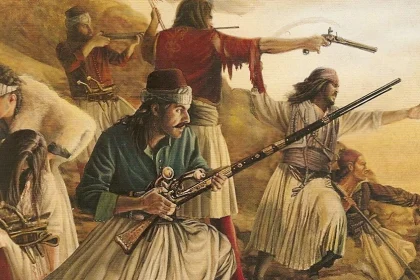
Here is how the Venetian Marino Sanuto describes the first presence of Greek soldiers in Venice: "On April 22, 1482, the first ship with cavalry arrived, carrying seven soldiers from Koroni, who, when they disembarked at Lido, paraded in their usual manner, in front of the unusual crowd, which they amazed with the speed of their horses and their horsemanship...the Soldiers are Greeks. and they wear wide cloaks and tall hats, some wear breastplates.
“They carry spears in their hands and a head-breaker and hang their sword at their side. They move like birds and remain constantly on their horses. They are accustomed to raids and have often plundered the Turks in the Peloponnese. They are worthy opponents of the Turks and act against them in a surprising way. They are loyal to their leader. They do not take prisoners, but instead cut off the heads of their enemies and collect a ducat for each head."
A contemporary, specific British historian insists on the view that Mercurius and the Stratiotes in general were exclusively of Albanian origin. However, Mercurius' biographer and protopalikaros, Ioannis (Tzanes) Koronaios, whom some naturalize as a Venetian – he was a Peloponnesian who had taken refuge in Zakynthos – states characteristically: "And the Lacedaemonians gathered together as princes. And other soldiers were chosen by the Macedonians."
Source: history-point.gr