
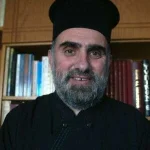

Saint Paisios, whose memory is celebrated on July 12, had God as his ally, guide, and inspirer since his childhood.
For everything, alone he felt weak and powerless. With God he gained strength. And the closer his ties with God became, the stronger his experiences were.
His peers, who are not alive today, but left their memories to their relatives, as well as his younger siblings, who saw him up close, as well as reports from himself and his relatives, have preserved incidents from his life in Konitsa, both his childhood and adolescence, as well as his solitary life.
Saint Paisios constantly struggled to free himself from sin and emerged as a field that belonged to God and was cultivated by Him.

From Igoumenitsa to Konitsa
When the family of Prodromos Enzepides, father of little Arsenios (later monk Paisios), who was then only 40 days old, along with other Asia Minor residents, was expelled from Cappadocia and specifically from Pharasa, he stayed for a short time in Piraeus and Corfu.
It was eventually promoted to Igoumenitsa with the prospect of permanent settlement and the granting of land, as part of the population exchange, since the Muslim Chams would go to Turkey.
In the end, the Asia Minor people did not leave and moved to Konitsa, even though they initially did not want to.
His testimony about the reason his family left Igoumenitsa and settled in Konitsa is significant, as it relates to the so-called Muslim "Tsami" people:
"When we had come from Cappadocia with the population exchange, they were going to give us some lands in Igoumenitsa. These were some Turkish villages, whose inhabitants would go to Turkey. We were waiting for them to leave. Our president (of the village of Farassa in Cappadocia, where Paisios came from) goes and the Turk tells him: 'You will leave, we will stay'"
What had happened, they had paid two deputies and had written them Albanians, Arvanites. So they stayed and we went to Konitsa. When Kondylis (who had in the meantime overthrown Pangalos) found out about this, he slammed his hand on the office but he could do nothing, the matter was over.
This little boy is going to be a Saint.
In Konitsa, where he reached the age of 2, Arsenios grew physically, but he also received many spiritual stimuli and manifested many mental gifts as a child.
In this way, as a child, he utilized the divine gifts he received during his baptism in Farasa, a few days after his birth, from the vicar of his village, Arsenios the Cappadocian, who gave him his name.
His behavior was so pious and his childhood life so saintly, that, as old Konitsa residents recall, almost all the residents of the town said: "This little boy will become a saint."
With the faith of his early years, he lived thereafter, until he fell Asleep. and he proclaims this faith even after his death.
Overcome poverty with God's wealth
His family faced many financial problems, so Arsenios was unable to continue his studies after finishing school.
He turned to the carpenter's trade, which he learned very quickly, but also worked on his father's estates.
In these circumstances, he realized more deeply the value of God's wealth.
What was this wealth for him? His salvation. He considered everything else secondary, temporary, that would one day be lost.
With the maturity of a great man, he understood that even if everything were to disappear here, if salvation were gained, everything would be gained. Because salvation meant for him a similarity to heaven.

He built a hermitage in the forest
From the age of 15, he would retreat every afternoon into the neighboring forest, where he had built a makeshift hermitage out of wood and branches, and there he would pray.
In fact, his parents were concerned about these isolations of his, but they tried in vain to stop them. His only inexhaustible source of comfort was prayer.
He needed prayer, because through it he spoke to God. Especially in every difficult situation and time, when waves wildly battered the boat of his life and that of his family.
In front of him is Christ
A young man from Konitsa, who was studying at the University, discovered his hermitage in the forest, approached him, struck up a conversation with him and attempted to shake his faith, with various arguments, in order to create doubts in him.
"There is no God," he told him. "It is possible to worship something you cannot see. We humans are not creatures of God, but we come from the ape."
Little Arsenios, in a state of panic, ran to the chapel of Saint Barbara.
In front of the image of Jesus, he burst into tears. Then, as he himself revealed, he saw Christ in front of him, holding an open Gospel.
After blessing him, he said to him: "Arsenius, I am the Resurrection and the Life. Whoever believes in me, even if he dies, will live."
This first supernatural revelation was to be followed by many others, which determined not only his path towards monasticism, but also the very content of his monastic life.
God's mercy, which has no limits, is a vast and bottomless ocean, it always strengthened him in his struggle.
The devil threatened him.
Once, as he was ascending to the Monastery of Stomio as a monk, a 1.30 hour walk, through the Aoos Gorge, he heard the devil threatening him with hatred, to shake his faith and his monastic dedication, so that he would perish in the horrible darkness of error and the traps of the evil one.
He tortured his body.
And during his stay at the Monastery of Stomio, he followed the will of God with asceticism, with self-denial, with sacrifices.
Ο αείμνηστος αδελφός του Λουκάς Ενζεπίδης, ανέφερε κάποτε σε ιερέα: “Ένα πρωινό, ανέβηκα από την Κόνιτσα στο μοναστήρι. Όταν έφθασα, βρήκα έξω από την Μονή και βαδίζοντας προς το δάσος τον αδελφό μου (όσιο Παίσιο) και τον νεαρό τότε θεολόγο Παναγιώτη Νέλλα. Ο Νέλλας είχε πάει προ ολίγου καιρού για να δοκιμαστεί κοντά στον Γέροντα, ώστε να γίνει μοναχός. Αυτό όμως που είδα όταν έφθασα κοντά, με συγκλόνισε. Και οι δυο τους εντελώς γυμνόποδες, βάδιζαν επάνω στις άγριες πέτρες και στα αγκάθια τού δάσους. Τα πόδια τού νεαρού θεολόγου πληγιασμένα και καταματωμένα. Δεν τόλμησα να τους πω τίποτε. Ο Παναγιώτης με κοίταξε ζωγραφίζοντας στα παγωμένα του χείλη ένα μελαγχολικό χαμόγελο. Όσο δε για τον αδελφό μου (όσιο Παίσιο); Μου έριξε ένα κοφτερό βλέμμα που δεν μου επέτρεπε όχι να πω ή να σχολιάσω κάτι, αλλά ούτε καν να… ανασάνω!”.
The miracle of Saint Arsenios to Elder Paisios
While he was At The monastery of Stomios, he went to corfu, where Saint arsenios The cappadocian was buried, and he collected his relics and secretly transported them to Konitsa.
He was leaving the next day and stayed in a hotel. He put the relics under his pillow and prayed.
Then, as he described, he felt two hands squeezing his throat, without seeing anyone near him.
Spontaneously, he cried out, “Saint Arsenius, help me.” He immediately felt a force freeing him.
Instead of sleeping, he prayed in the Temple
He visited a village in Konitsa, where he spent the night. He was hosted in a house, where he was offered coffee, but he did not accept any food.
Instead of sleeping in the house, he spent the night praying in the nearby church of the Virgin Mary.
He struggled to live this way and thus he was truly Orthodox. Not only with Orthodox faith, but also with Orthodox life and ethics.
Something that led him safely to the harbor of the world to come, to the eternal joy of the Kingdom of God.

Money boxes in the neighborhoods for the poor
He had left a piggy bank in certain houses in the neighborhoods of Konitsa. He begged the people of Konitsa to contribute their money so that the management committee, which he had appointed, could purchase food, clothing, and medicine for the poor.
Supporting one's fellow human beings, according to Paisios, is a method of shielding the soul, an act of light.
He converted the Evangelicals of Konitsa
During his stay as a monk in Konitsa, in the late 1950s and early 1960s, Evangelicals who came from Farasa in Cappadocia lived in Konitsa.
They had also founded a church and led away about fifty people from Konitsa. He approached these people one by one and convinced them that they had been led away by delusions and that they were not keeping themselves pure and undefiled.
He also made them understand that what they want most deeply, happiness, joy, is given by God and is His treasure. The result? The Evangelical church emptied.
Four years at the Monastery of Stomio
Στη Μονή Στομίου Κόνιτσας, ο όσιος Παΐσιος, ο ονομαστός αυτός άγιος της εποχής μας, έζησε για τέσσερα χρόνια στην αρχή του μοναστικού του βίου. Αφού για πέντε ολόκληρα χρόνια υπηρέτησε στο στρατό ως ασυρματιστής και για τρία χρόνια εργάστηκε στην Κόνιτσα, το 1953 αναχώρησε για το Άγιο Όρος, όπου εκάρη μοναχός. Μετά από πέντε χρόνια, το 1958, μόνασε, έως το 1962, στην εγκαταλελειμμένη Μονή Στομίου Κόνιτσας, στην οποία έκανε πολλές εργασίες, και που στα χρόνια, που ακολούθησαν, έγινε γνωστή όχι μόνο πανελληνίως, αλλά και διεθνώς, λόγω της παρουσίας του σ’ αυτή.
In fact, he is considered the renovator of the Monastery, since he himself, through personal effort, managed to raise it, even carrying heavy loads from under the river with his hands, mobilizing and raising awareness among the good residents of the surrounding villages, collecting contributions that the Virgin Mary sent him with pious people, gathering workers, and making window frames, floors, and roofs himself, like a carpenter.
A project that was continued by the current abbot of the Monastery, Fr. Kosmas Siozos, who saw to it that a chapel was built within the Monastery in the name of Saint Paisios, as well as that the saint's cell was renovated so that it could be visited.
His cell, which is small and narrow, is preserved, and inside there is the wooden bed, which he had built himself and was his only piece of furniture. Various icons are found inside the cell. There as a “fruitful tree, “as a shade-loving tree”, which nourished and shaded many.
A certain person, who, when he was in his darkest despair, would walk an hour and a quarter from Konitsa to Stomio, would stand outside his cell for some time, without even trying to speak to him. And then he would leave for the day's work.
Elder Paisios felt this presence. The elder felt a lot and he made others feel a lot too. In his cell in Stomio, he did not easily accept people. He would turn around prayerfully to taste the sweet fruits of God's love.
And he said: Don't get lost. Overcome the thorns and look at the flowers that bloom on your path.

Ρε παιδιά, όλοι το λένε, αλλά πόσο αλήθεια είναι αυτά; Κάτι ακούγεται υπερβολικό. Πρέπει να το δω για να πειστώ.
Η λεπτομερής καταγραφή βιωμάτων συμβάλλει στην τεκμηρίωση της διαχρονικής πνευματικής επιρροής. Αξίζει διερεύνηση της κοινωνικής τους απήχησης.