Two centuries ago, when the rebellious Greeks were fighting to gain their freedom from the Turkish yoke (1821) and to shape their national consciousness, the concept of "National Literature" was born, in which the role of language was decisive.
And it was decisive, because it carried — from pre-revolutionary and, mainly, post-revolutionary Greece — the ideas and models of the Modern Greeks, who — using Western European thoughts as a springboard — cultivated their own political and cultural choices.
Since then, "a disproportionately intense intellectual and literary activity began to intensify" (Linos Politis: History of Modern Greek Literature, 1969), which activated the role of language while simultaneously giving impetus to the historicity of literary writing.
In the period 1830-80, in fact, a “coincidence between catharsis and romanticism” is observed (Kon. Dimaras: Greek Romanticism, 1987) and “the formation of an entire literary era”, where the dominant representatives of the generation of the 80s were E. Rhodes, K. Ragkavis, Dim. Kampouroglou, A. Papadiamantis, Io. Psycharis, Ag. Vlachos, D. Paparrigopoulos, K. Palamas, G. Drosinis and Dion, Solomos.
The Rhodes-Vlachos dispute in 1877 escalated the tension between the supporters of Katharevousa and Demotika (Language Question), which was based — not so much on the confrontation of personalities — as on mentalities.
Thus we reached linguistic exaggerations ("hairy" vernacular VS "primitive language") during the struggle of the writers of the '80s generation to establish a single language for the people.
A language that continued to run intertextually in the immortal words of Makrygiannis "For these borders I fight" and "For these we fought" (General Makrygiannis "Memoirs", volume B).
The result of this was the coupling of the language with the aspirations of the Greeks' struggle for the liberation of the Turkish-occupied regions of the homeland. Then, through searches and struggling efforts, the unified national language was formed as proof of our common origin and national continuity.
The Language Issue had taken on a national dimension through the renewal efforts of the 1980s generation, which constituted a movement, in essence, into which individual opinions sometimes intruded (repositories of ideas, I would say, with a "regulatory-normative character").
Ideas clearly influenced by the scattered texts of Adamantios Korais from the last period until his death (1804-1833), where the message for "creating a nation-state model with regard to the prevailing status of independent Greece" was prominent.
A model that considered a return to the ancient Greek language impossible and fervently supported — as "national" — the spoken, modern, everyday language of that era, where the ancient and the popular met.
This theoretical debate about language, with... "fueled by" Korai's views on the "meeting" of archaic-popular on the rails of the Greek nation (ed.: Linos Politis calls the identification of language-nation in the texts of the main exponent of the Modern Greek Enlightenment, Korai) continued to be discussed until the 20th century.
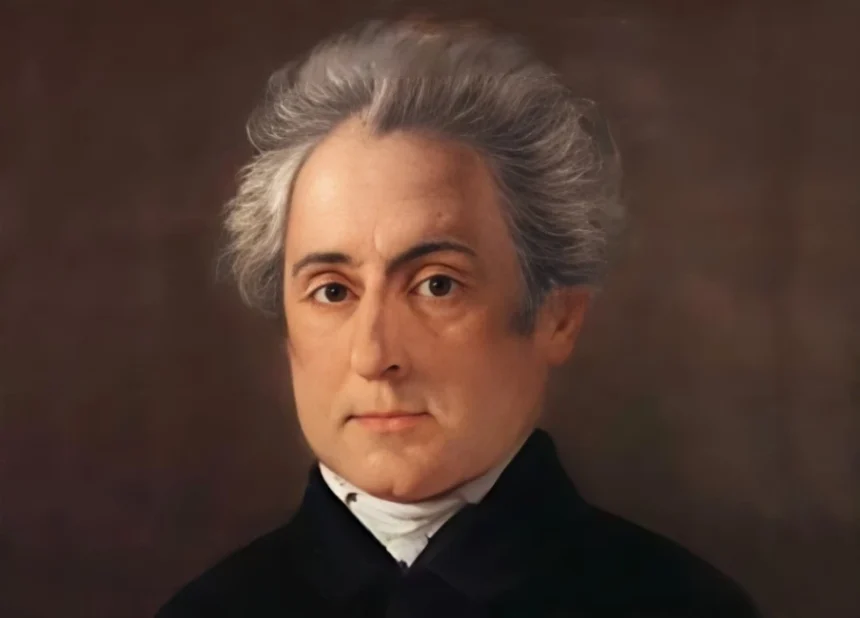
Throughout the entire linguistic dispute, meanwhile, our national poet Dionysios Solomos (whose memory we honor every February 9th, International Greek Language Day, Government Gazette B' 1384/24/04/2017) did not remain uninvolved, but actively participated with his own proposals.
Proposals that did not identify the written with the spoken language and indirectly gave priority to the Elementary language. Something that Psycharis did directly in 1888 (“My Journey”) based on the experiences he had gained while traveling in free and enslaved Greece in 1886.
Solomos, however (1798 –1857), also supported the development of the Demotic language, directly rewarding its choice: “Submit first to the language of the people and, if you are good enough, master it” (K. Dimaras: Essay on Poetry, 1990).
Beyond his choice of language, however, what characterizes him is his high-quality creativity. Solomos was a national creator. The first in the field of Greek Literature truly gifted with fiery patriotism and language that reflected his creative spirit, even if he violated the rules of Grammar in the formality of Orthography due to a lack of relevant knowledge.
Also, in contrast to the “plebeian” Kalvos (“plebeian” due to his limited education) — our national poet had acquired (as an aristocrat) superior culture and Greek education from that of his time, which he “married” with the Italian one from which he started.
He certainly acquired a serious knowledge of the greek language gradually, since in his childhood he was under the linguistic Influence of An italian teacher. this is why his compatriot and Student, The writer Iakovos Polylas, says: "Solomos' 'education' began with italian letters."
Despite all this, however, the influence of his Greek mother, Angeliki Nikli (a woman of a simple, lower social class than that of his count father, Nikolaos Solomos, as his maidservant), who spoke, lulled and wrote to her son (when he was in Italy) in a warm folk language full of picturesqueness and... "maternal" grace, had a magical effect on Italian culture.
Later, as he grew up, he was influenced linguistically by famous representatives of Italian pre-Romanticism (Monti, Manzoni, Foscolo) and the representatives of the French "radical" Enlightenment (Contillac, D'Alembert), whose forerunners were the Englishmen Bacon and Locke (see European Enlightenment, History of Ideas, 16th-17th-18th centuries).
These influences are good and holy, of course, but the essence of Solomos' transformation into our national poet lies elsewhere. It lies in the identification of language with his national consciousness "as a living reality" deeply influenced by the Cretan tradition. "As a living reality that we must know. As an ideal that we must conquer" (Kon. Dimaras: History of Modern Greek Literature).
Which means that the prophetic poet of the 158 verses of the "Hymn to Freedom", in addition to giving the Greek vernacular language (which he considered "a force that incessantly creates") intellectual capacity, "grafted" it with the idea of Hellenism and the freedom of Greece ("Do I have anything else in mind, apart from freedom and language?"), as evidenced by his choice to become a member of the Philiki Eteria.
He also inoculated it with Greek tradition (folk language, homeland and tradition were one in Solomos' soul). He inoculated it with our folk culture and our folk songs. The value of the Greek folk linguistic tradition for Solomos is at the antithesis of the value of linguistic knowledge and that is why he always used to contrast the first with the second.
Το μόνο που θα μπορούσε να του προσάψει κανείς στο ζήτημα της γλώσσας ήταν η ανορθογραφία του, την οποία αντιπαρερχόταν με την αντίληψη (η οποία δεν με βρίσκει σύμφωνη, αλλά είναι το έλασσον μπροστά στο μείζον της ποιητικής προσφοράς του) έχοντας την πεποίθηση ότι η ελευθερία βρίσκεται στο πνεύμα και όχι στο γράμμα (ενν. τον ορθογραφημένο λόγο). Σε κάθε περίπτωση, πάντως, η ταύτιση της λαϊκής ελληνικής με τον Ελληνισμό αποτέλεσε την ενωτική γραμμή των οδηγών της ζωής του Σολωμού, ενώ ο ίδιος έγινε πηγή έμπνευσης (ως γενάρχης της Επτανησιακής Σχολής) για τους ”μαθητές” στον ”σολωμικό” κύκλο επιρροής του.
And because Hellenism was the alpha and omega in his poetic inspiration and creation, it is worth emphasizing in conclusion that in it — above all others — Solomos saw the reflection of the moral idea, which takes on historical dimensions when it is identified with national duty and highlights the concept of moral freedom.
Freedom which is transformed into sacrificial acts for the homeland, such as those of the people of Messolonghi in Solomos' life's work "Freemen Besieged" (a work with the aroma of Socratic philosophy and characteristics of psychographic ideography), where the poet reduces their struggle to the struggle of man for his moral and inner freedom based on the historical event of the siege of the city of Messolonghi by the Turks.
The Turks of Kioutachi who bombarded the heroic "field of sacrifice" (1825-1826) until they brought it to its knees at dawn at the climax of the drama, on the occasion of the desperate exodus of its inhabitants on the night between 10 and 11 April 1826 (Palm Sunday).
Krinio Kalogeridou