
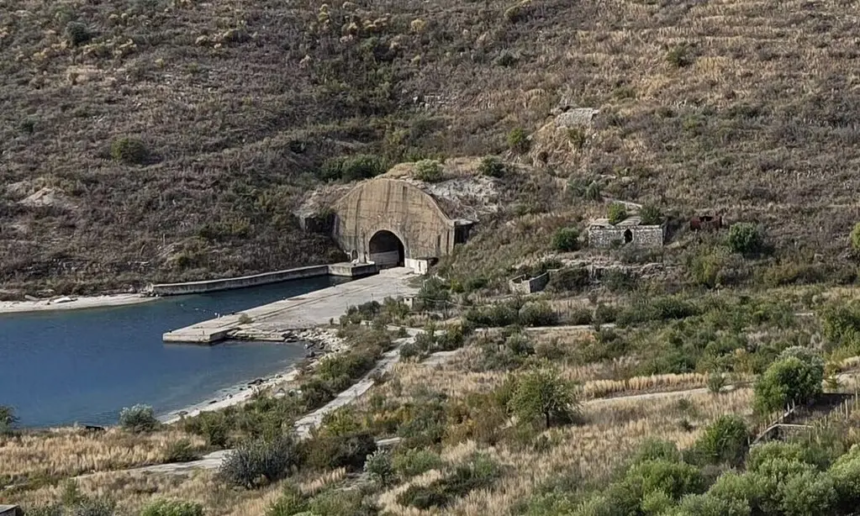
Behind the impressive landscape of Porto Palermo, in the Himara region, lies one of the most characteristic remnants of Albania's military isolation. A huge naval portico, carved into the rock and accessible from the sea, retains to this day the imprint of the era of Enver Hoxha, when suspicion of the outside world was transformed into fortifications, shelters and forbidden zones.
The facility is often described as an “underwater base”. More precisely, it is an underground naval shelter with a sea entrance, built into the coastal mountain range. With a length of approximately 650 meters and a height reported at 12 meters, the gallery allowed the concealment and protection of vessels under the natural cover of the mountain. The entrance from the bay was the passage from the open sea to a controlled military area.

Construction began in the late 1960s and evolved into a multi-year project. An academic study on the military architecture of Albania describes work that lasted more than fifteen years, involving soldiers and engineers, including people serving their military service. Behind the size of the facility was therefore a long-term mobilization of human resources and state resources.
The geopolitical background explains the choice. After the break with the Soviet Union, the hoxha Regime turned to china, Seeking military and technical support. the Creation of the shelter is linked to this cooperation, while its completion continued with albanian means after the cessation of chinese aid. the Successive distancing from the allies reinforced a defensive perception that treated almost any external factor as a potential threat.
The name "submarine tunnel" has prevailed and is now used in the official presentation Of the site. however, descriptions of its exact operational use vary, with some also referring to smaller warships. the Distinction is important for the historical presentation of the base, especially if its conversion into a visitor site proceeds.
Today, the design includes a museum dedicated to the Cold War and the history of the facility. The international architectural competition, initiated by the Albanian Ministries of Defense and Tourism, Culture and Sports, includes the reuse of the old barracks. The planned functions even include the possibility of visitors staying for one or more days within the infrastructure of the former base.
The design concerns a protected area and connects the portico with the castle of Porto Palermo, the small coves and the surrounding landscape. At the same time, part of the complex is planned to continue to be used periodically by the Albanian Navy. Therefore, the prospect of public access coexists with the maintenance of military activity.
The idea of museum use, however, has a past. As early as 2010, Elisabetta Terragni's architectural office had prepared a proposal entitled "Cold War Panorama", in collaboration with Jeffrey Schnapp and Daniele Ledda. Today's competition therefore revives a debate that has remained open for years.
For the Rama government, the essential criterion will be implementation. Transparency in interventions, protection of the coastal environment and clear access conditions are needed. The history of a closed military area requires documentation and public control at every stage of its development.
In Himare, such a place of memory must also highlight the human cost of the era that created it. The impressive dimensions of the gallery can attract the eye. The value of the future museum will be judged by how clearly it explains the history behind the rock.




Akoma me ta kataramena tou Xotza asxolounte? T’ afto to pragmatiko mousio na ginei; Fovos, oxi istoria, ti na deiksei.
Είχαν φτιάξει κρυψώνες για φόβο. Τώρα θα μπαίνουμε με εισιτήριο για φωτό. Τελικά, όλα γίνονται θέαμα.